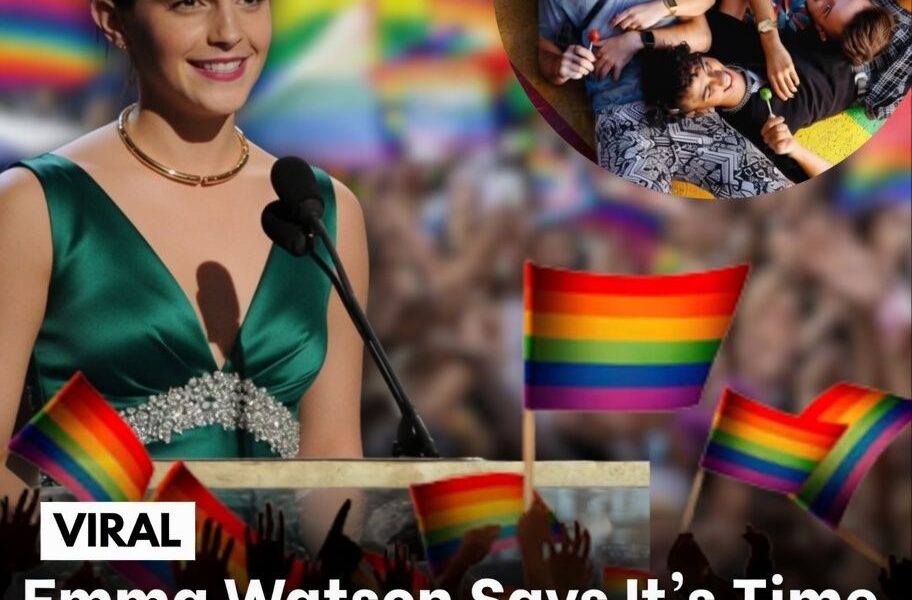
Emma Watson, Gender Identity, and the Growing Debate Between Biology and Modern Activism. hyn

Emma Watson, Gender Identity, and the Modern Conflict Between Biology and Identity
Emma Watson has once again found herself at the center of a cultural debate — this time over gender identity, biology, and the increasingly polarized conversation surrounding what it means to be male or female in modern society. Known globally not only as an actress but also as a vocal activist, Watson has often supported inclusive language around gender and identity, encouraging people to think beyond rigid traditional categories. Supporters praise her for compassion and progressiveness. Critics argue that ideas like “gender as a spectrum” blur biological reality and create social consequences that society is only beginning to confront.
The debate itself is far larger than one celebrity. Emma Watson simply represents a broader cultural shift happening across schools, media, politics, and social institutions. At the center of the discussion lies a difficult question: Can society acknowledge biological sex as real and important while also respecting people whose gender identity does not align with their biological sex?
For many people, the answer should be simple. Biological sex is rooted in physical reality. Human beings are born male or female based on reproductive biology, chromosomes, hormones, and anatomy. Across most of history and science, sex has been understood as a biological classification connected to reproduction and physiology. Critics of gender ideology argue that redefining sex as fluid or purely self-identified risks disconnecting society from objective reality. They worry that language itself is being reshaped in ways that deny basic scientific truths.
These concerns are especially intense when discussions move beyond language and into policy. Debates over women’s sports, prisons, shelters, bathrooms, and medical treatment for minors have transformed what was once considered a niche academic issue into a mainstream political and ethical conflict. Many women’s rights advocates argue that sex-based protections exist for legitimate reasons rooted in biology, safety, and fairness. They fear that if biological distinctions become socially or legally irrelevant, hard-won protections for women could weaken over time.
Sports is one of the clearest examples frequently raised in public debate. Critics argue that biological differences in strength, bone density, lung capacity, and muscle development can create unfair advantages in women’s competitions when transgender athletes who experienced male puberty compete against biological females. Supporters of gender inclusion respond that policies can balance inclusion and fairness without excluding vulnerable individuals entirely. Yet the issue remains emotionally charged because it forces society to weigh competing values rather than simple right-versus-wrong answers.
Another major area of concern involves children and adolescents. Some parents, doctors, and commentators worry that social media, peer influence, and ideological pressure may encourage vulnerable young people to interpret normal struggles with identity or adolescence as evidence that they were “born in the wrong body.” They fear that rapid affirmation models and medical interventions may move too quickly for individuals whose identities are still developing. Others argue that gender dysphoria is real, that supportive environments reduce suffering, and that denying care can lead to serious mental health consequences. The disagreement reflects a deeper uncertainty about how society should approach identity, autonomy, and psychological development in young people.
At the same time, many transgender individuals describe experiences that are deeply personal and painful. For them, discussions about identity are not abstract political theories but lived realities involving isolation, misunderstanding, and discrimination. They often argue that recognizing gender identity is not about denying biology but about acknowledging the complexity of human experience. Supporters of inclusive approaches believe compassion requires allowing people to live in ways that reduce suffering and affirm their sense of self.
This is where the public conversation often collapses into hostility. One side fears that compassion is being used to erase biological truth. The other fears that appeals to biology are being used to justify exclusion and stigma. Social media amplifies the conflict by rewarding outrage, reducing nuanced discussions into slogans, hashtags, and tribal loyalty tests. People are frequently pressured to choose between two extremes: either biology means nothing, or identity means nothing. In reality, most ordinary people likely occupy a more complicated middle ground.
Emma Watson’s role in this debate reflects the influence celebrities now hold in shaping social conversations. Public figures are no longer expected merely to entertain; they are expected to speak on politics, morality, identity, and justice. Some audiences admire celebrities who use their platforms for advocacy. Others question whether fame grants authority on scientific, medical, or philosophical matters. Regardless, celebrity voices undeniably shape cultural attitudes, especially among younger audiences.
The deeper issue beneath all of this may not simply be gender itself, but society’s growing struggle to balance individual identity with shared reality. Modern culture increasingly emphasizes personal truth, self-definition, and autonomy. At the same time, societies still depend on common definitions, institutions, and biological realities to function coherently. The tension between those forces is unlikely to disappear anytime soon.
A healthy society should be capable of holding multiple truths simultaneously. Biological sex is real and meaningful. Human dignity is also real and meaningful. Acknowledging one does not necessarily require erasing the other. It should be possible to defend women’s rights, preserve fairness in important spaces, and still treat transgender individuals with respect and humanity. Likewise, compassion should not require silencing scientific discussion or labeling disagreement as hatred.
The problem today is that many conversations no longer allow room for complexity. People are encouraged to pick teams instead of thinking carefully. Those who raise concerns about policy are often dismissed as intolerant, while those advocating inclusion are sometimes portrayed as enemies of reality itself. This atmosphere creates fear, resentment, and division rather than understanding.
Emma Watson’s comments, whether one agrees with them or not, tap directly into one of the defining cultural debates of this generation. The issue is not going away because it touches biology, identity, language, rights, ethics, medicine, and the future of social norms all at once. The challenge moving forward is whether society can discuss these issues honestly without losing either scientific integrity or human compassion.
Because ultimately, a civilization strong enough to face difficult truths should also be compassionate enough to treat people with dignity — even in disagreement.