Magyar verweigert Merz die Zustimmung und liefert bei Berlin-Besuch eine unvorstellbare Überraschung . hyn

Magyar verweigert Merz die Zustimmung und liefert bei Berlin-Besuch eine unvorstellbare Überraschung
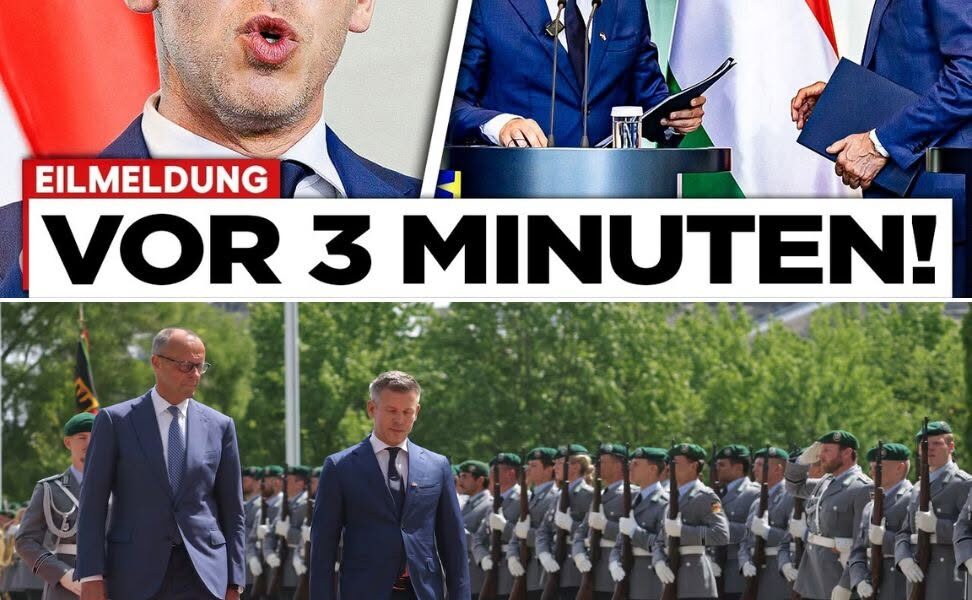
The political atmosphere in Berlin was filled with anticipation as Hungarian Prime Minister Péter Magyar arrived for his first official visit to Germany since taking office. Following his historic election victory and the end of Viktor Orbán’s long era of leadership, many European observers viewed the meeting with German Chancellor Friedrich Merz as a symbol of a new chapter in European politics. Expectations were high. Some hoped for immediate agreement on key European issues, while others anticipated a closer alignment between Budapest and Berlin.
What unfolded, however, was far more complex than a simple diplomatic success story.
From the beginning of the visit, Merz welcomed Magyar warmly and emphasized Germany’s willingness to support Hungary’s return to what he described as the political center of Europe. The German Chancellor praised the democratic transition that had taken place in Hungary and expressed hope for stronger cooperation on economic and security matters. The meeting appeared to signal a fresh start in relations between the two countries after years of tension during the Orbán era.
Yet despite the friendly atmosphere, Magyar made it clear that a new Hungarian government would not automatically agree with every German position.
During the joint press conference, Magyar openly stated that he had never promised Hungary and Germany would always share the same views. While emphasizing cooperation, he stressed that Hungary would continue to defend its own national interests and make independent decisions on matters of foreign policy and European integration. This message immediately attracted attention among political commentators because it challenged the assumption that Hungary’s change in leadership would eliminate all disagreements within the European Union.
The most significant differences emerged over Ukraine policy.
Merz urged Hungary to fully support the European Union’s common approach toward Ukraine and emphasized the importance of European unity in the face of ongoing security challenges. Magyar, however, maintained a more cautious position. Although his government has moved closer to mainstream European partners than the previous administration in several areas, he reiterated Hungary’s reluctance to become directly involved in military support measures. This demonstrated that while relations between Berlin and Budapest may be improving, important policy differences remain.
For many observers, the real surprise of the visit was not a dramatic diplomatic confrontation but rather Magyar’s political confidence.
Rather than appearing as a junior partner seeking approval from larger European powers, he presented himself as a leader determined to pursue cooperation without sacrificing national independence. This approach contrasted sharply with expectations that Hungary’s new government would simply align itself with Berlin on every major issue.
Another unexpected moment came when Magyar used the international spotlight to criticize Hungarian President Tamás Sulyok, describing him in highly critical terms during discussions with journalists. Such remarks were unusual during a foreign visit and generated considerable debate both in Hungary and abroad. The comments demonstrated that Magyar was willing to continue domestic political battles even while representing his country on the international stage.
Beyond politics, the visit also revealed a more personal side of the Hungarian Prime Minister. News outlets reported that Magyar spent time enjoying traditional Berlin street food, including currywurst and a local beer. While seemingly insignificant compared to major geopolitical discussions, these moments helped shape his image as a more approachable and relatable political figure. The images quickly circulated online and became part of the broader narrative surrounding his Berlin trip.
Ultimately, the visit highlighted a reality often overlooked in modern politics: a change in leadership does not automatically eliminate national differences. Germany and Hungary may now enjoy warmer relations than in previous years, but both governments continue to have distinct priorities and perspectives.
For Merz, the meeting represented an opportunity to strengthen European unity and rebuild trust with an important partner. For Magyar, it was a chance to demonstrate that Hungary could be constructive within Europe while still maintaining an independent voice.
Far from delivering a diplomatic shock, Magyar’s visit offered something perhaps more significant: a reminder that genuine partnerships are not built on unconditional agreement. They are built on mutual respect, open dialogue, and the ability to cooperate even when disagreements remain.
As Europe faces increasingly complex political, economic, and security challenges, the evolving relationship between Berlin and Budapest may become an important test of whether unity and diversity can successfully coexist within the European project.