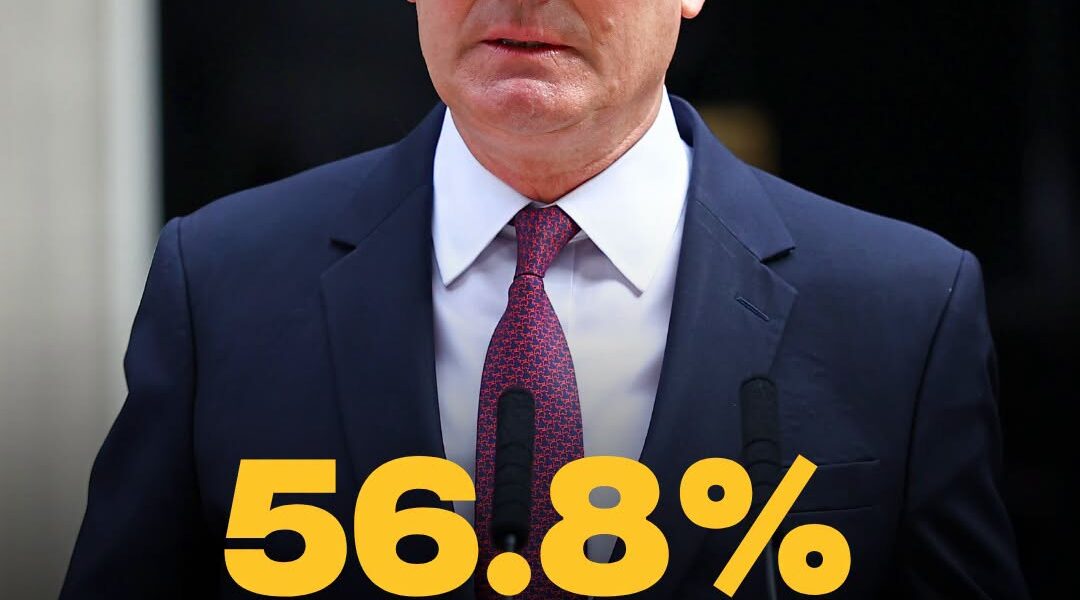
The resignation of Keir Starmer as Prime Minister has sparked intense debate across the United Kingdom, with a new poll suggesting that many people believe he was treated unfairly during his time in office. Despite facing months of criticism, declining approval ratings, and growing pressure from both political opponents and members of his own party, a majority of respondents now appear to feel that the attacks against him went too far.
According to a poll conducted among the JOE audience, 56.8% of respondents said that Starmer had been treated too harshly before his resignation. In contrast, 43.2% believed that the criticism he faced was justified. The results have surprised many political observers, especially considering the significant challenges Starmer encountered in the months leading up to his departure.
Starmer announced his decision to step down after what many described as a prolonged period of political turbulence. Questions about his leadership had intensified as public dissatisfaction grew over a range of issues, including the economy, public services, immigration, and the overall direction of the government. Critics argued that he struggled to deliver on key promises and failed to connect with voters who expected significant change.
However, supporters of the former prime minister insist that much of the criticism ignored the difficult circumstances he inherited. They point out that Starmer faced a complex economic environment, international instability, and ongoing pressures on public finances. In their view, many of the challenges confronting his government were deeply rooted and could not be solved quickly.
The poll results suggest that, following his resignation, some members of the public may be reassessing his time in office. Political leaders often experience a shift in public perception after leaving power, as voters begin to evaluate their record with greater distance and less partisan emotion. For Starmer, this appears to be happening remarkably quickly.
Several political commentators have noted that Starmer frequently found himself under attack from multiple directions. Opposition parties accused him of ineffective leadership, while some critics within Labour argued that he was either too cautious or too willing to compromise. At the same time, sections of the media closely scrutinized nearly every major decision made by his government.
Supporters argue that this constant pressure created an environment in which achievements were often overshadowed by controversy. They point to areas where the government made progress and claim that these successes received far less attention than political disputes or policy disagreements.
The findings also raise broader questions about the nature of modern politics. Increasingly, political leaders face intense public scrutiny through traditional media and social media platforms. Every decision can trigger immediate reactions, criticism, and online debate. Some analysts believe this environment makes it more difficult for leaders to govern effectively and may contribute to rapid declines in public trust.
Meanwhile, Starmer’s resignation has opened a new chapter for the Labour Party. Attention is now turning toward the leadership contest and the future direction of the government. Potential successors are already being discussed, and party members will soon face important decisions about how to rebuild public confidence.
Whether history ultimately judges Starmer favorably remains uncertain. His supporters see a leader who faced extraordinary challenges and was often judged unfairly. His critics argue that public dissatisfaction reflected genuine concerns about his performance. What is clear, however, is that the debate surrounding his legacy is far from over.
For now, the poll offers a striking snapshot of public sentiment: despite the criticism that contributed to his resignation, a majority of respondents believe Keir Starmer was treated too harshly during his time as Prime Minister. As Britain looks ahead to a new political era, discussions about his leadership and legacy are likely to continue for years to c