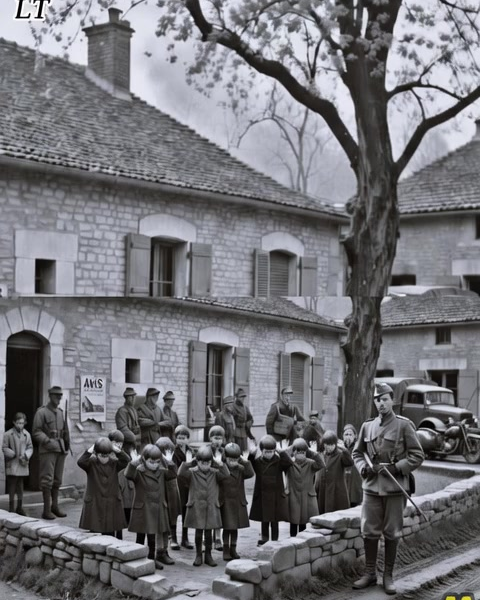

On the morning of April 6, 1944, forty four children sat down in a classroom in the small French village of Izieu.
The morning felt ordinary.
Pencils scraped softly against paper. Chairs creaked against the wooden floor. A teacher wrote simple exercises across a chalkboard while several younger children whispered to each other, still half asleep.

Outside, the hills of southeastern France were covered with soft spring mist. Birds moved through the trees. The war that had swallowed so much of Europe felt strangely distant here.
For a brief moment, the children believed they had found safety.
The building where they lived was known as the children’s home of Izieu. It stood on a quiet hillside above the Rhône Valley. From the outside it looked peaceful, almost cheerful, with windows that opened toward green fields and winding roads.
Inside those walls lived forty four Jewish children who had already lost almost everything.
Many had been separated from their parents months earlier. Some had fled from cities where Jews were hunted openly in the streets. Others had crossed borders in the middle of the night with strangers guiding them through forests.
A few had watched their mothers and fathers disappear onto trains.
The home at Izieu was meant to be a refuge.
It was organized by members of the French resistance and humanitarian groups who were trying to hide Jewish children from Nazi authorities. The caretakers worked quietly, constantly moving children from place to place whenever danger grew too close.
For many of the children, Izieu was the first place in months where life began to resemble childhood again.
They attended small lessons each morning.
They played games in the yard.
They drew pictures with colored pencils.
Some even laughed.
Photographs taken during those months show children smiling in the sunlight. One boy stands proudly in short trousers, hands tucked into his pockets as if posing for a family portrait. A small girl with dark hair holds a doll almost as large as she is.
They look like ordinary children in an ordinary home.
But behind every photograph was a story of loss.
Ten year old Sabine wrote letters to her father, asking when he would come to bring her home. She believed he was working somewhere far away and that the war would soon end.
She did not know he had already been deported.
Another child carefully folded a drawing of a house and slipped it into an envelope addressed to his mother.
The letters were never delivered.
Still, the children continued writing.
Hope was easier than truth.
The adults who ran the home tried to maintain routines. They believed that ordinary schedules might protect the children from the weight of war pressing in on the world beyond the hills.
Breakfast.
Lessons.
Afternoon games.
Evening stories.
Sometimes the caretakers stood near the windows watching the road below, scanning for unfamiliar vehicles.
They knew danger could arrive without warning.
And on the morning of April 6, 1944, it did.
Shortly after lessons began, the sound of engines broke the quiet of the valley.
Trucks climbed the narrow road toward the house.
Several vehicles stopped outside the building.
Men stepped out wearing long coats and military boots.
They were members of the Gestapo.
The raid was led by Klaus Barbie, the Gestapo chief of Lyon. Known later as the Butcher of Lyon, Barbie had spent months searching for Jewish children hidden throughout the region.
Someone had informed him about the house in Izieu.
Inside the classroom, the teachers heard the vehicles before they saw the men.
A moment later the doors burst open.
Boots echoed through the hallways.
Some children froze.
Others looked toward their teachers, confused.
One of the caretakers tried to calm them, speaking gently as armed officers moved through the rooms.
Several younger children clutched their notebooks as if they were still expected to finish their lessons.
A boy grabbed his friend’s hand.
One girl asked if they were being moved to another safe house.
No one answered.
The officers ordered everyone outside.
Forty four children.
Seven adult caretakers.
All forced toward the waiting trucks.
Neighbors in the village watched silently from their windows. Some later said they had never seen so many children so quiet at once.
The trucks drove away down the hill.
Within hours the children were transported to Lyon.
From there they were sent to Drancy, the transit camp outside Paris where thousands of Jews were gathered before deportation east.
The journey continued by train.
Most of the children were sent to Auschwitz.
The youngest child from Izieu was only four years old.
None survived.
Even the older children who were strong enough to work were killed.
The adult caretakers who had tried to protect them were murdered as well.
In the vast horror of the Holocaust, millions of lives were lost.
But numbers cannot carry the weight of a single child’s voice.
What remains from Izieu are fragments.
Letters that never reached their parents.
Drawings made with colored pencils that somehow survived the war.
Photographs of children who believed tomorrow would come.
Decades later, the house at Izieu became a memorial.
Visitors walk through the rooms where the children once slept in narrow bunk beds.
They see photographs hanging along the walls.
They read the names.
Sabine.
Albert.
Mina.
Arnold.
Ages four.
Seven.
Twelve.
Seventeen.
Each name is a story interrupted.
Each room holds a silence that feels heavier than words.
For many years the world did not know the full details of what happened that morning.
But in 1987, more than forty years after the raid, Klaus Barbie was finally brought to trial in France.
During the proceedings, investigators presented evidence from Izieu.
Letters written by the children.
Records from the raid.
Witness testimony from those who had watched the trucks leave the hillside.
The story of the forty four children became one of the most powerful pieces of evidence in the case.
Their lives, once nearly erased by war, helped prove the crimes committed by those responsible.
Barbie was convicted of crimes against humanity.
The trial reminded the world that memory can survive even the darkest attempts to erase it.
Today the Maison d’Izieu stands not only as a memorial but as a promise.
A promise that the names of those children will never disappear.
Visitors who walk through its rooms often pause in front of the photographs.
They see smiling faces.
School clothes.
Children who believed their lives were just beginning.
And for a moment, the silence of the hillside returns.
Birds moving through the trees.
Mist over the valley.
A quiet morning that once seemed safe.
A classroom where forty four children sharpened pencils and opened notebooks, believing that tomorrow would come.
Tomorrow never arrived for them.
But their names remain.
And as long as they are spoken, the world remembers the morning when forty four children sat down for class and never came home.