
The Forgotten Journey of Clotilde Nissim
February 6, 1944.
In the middle of one of the coldest winters of the Second World War, a transport train moved slowly across occupied Europe.

Inside the sealed wooden cars were nearly seven hundred Italian Jews.
Only days earlier they had been arrested in cities like Milan and Verona. The arrests came quickly, often before sunrise. Doors were forced open by police. Families were ordered to gather what they could carry.
Most believed they were being relocated.
Some still believed the war would end before anything worse could happen.
Inside the train cars the air was thick and damp. People stood shoulder to shoulder in darkness. The journey lasted for days. There was almost no food. Very little water. No place to sit except the cold wooden floor.
Mothers tried to comfort their children.
Fathers tried to appear calm even when fear pressed heavily on their faces.
Elderly passengers clutched papers and identification documents that had once defined their place in society. Birth certificates. Marriage records. Letters.
On that train was a woman named Clotilde Nissim.
She was seventy nine years old.
Clotilde had lived most of her life in Italy. She had experienced decades of ordinary life before the war arrived and turned everything upside down. She had watched cities grow, families expand, traditions continue through generations.
She had raised children.
She had seen grandchildren.
She had collected the quiet memories that form the foundation of a full human life.
But now she stood inside a crowded train car with hundreds of others, traveling toward a destination no one fully understood.
Outside, the winter landscape passed slowly through cracks in the wooden walls.
Snow covered fields.
Dark forests.
Villages that appeared briefly before disappearing again into the distance.
No one inside the train knew exactly where they were going.
But rumors spread quietly among the passengers.
A place called Auschwitz.
Some had heard the name before.
Most had not.
On the morning of February sixth the train finally stopped.
Metal wheels screamed against frozen rails as the cars came to a halt beneath powerful floodlights.
It was night.
The doors were pulled open with sudden force.
Cold air rushed inside the train.
Shouting followed.
Armed guards ordered the passengers out.
After days inside darkness the bright lights were almost blinding. People stumbled as they climbed down from the train cars onto the frozen ground.
Families tried to stay together.
Parents held tightly to children.
Elderly passengers moved slowly, guided by younger hands.
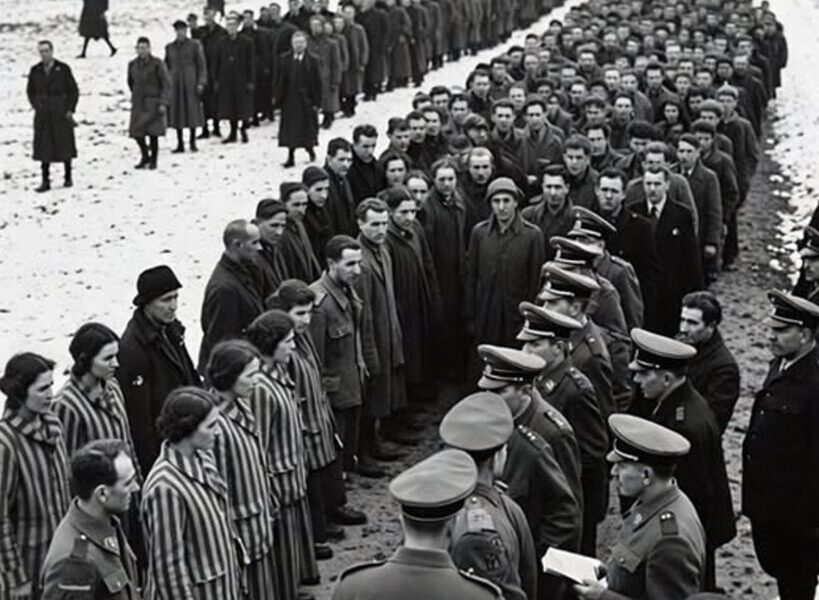
The prisoners were directed into lines.
This was the moment the guards called selection.
But the word suggested a choice that never truly existed.
Doctors and officers watched the line move forward.
Each person passed before them.
A glance.
A gesture.
Left or right.
The decisions took seconds.
Those considered strong enough to work were sent one direction.
Everyone else was sent another.
No explanations were given.
No appeals were allowed.
On that night nearly seven hundred people stood in the line.
When the process ended, only one hundred twenty eight had been selected for forced labor.
Ninety seven men.
Thirty one women.
The remaining five hundred seventy two people were told they would go to showers.
They were told to wait.
Among them was Clotilde Nissim.
She had lived seventy nine years.
In the eyes of the system that processed people on that ramp, those years meant nothing.
She was guided toward the group that would not return.
For decades afterward, records listed the event simply as numbers.
A transport.
An arrival.
A selection.
Statistics written in cold ink.
But statistics cannot tell the story of the individuals who stood on that frozen ground.
Each of the nearly seven hundred people had carried a life behind them.
Memories.
Families.
Dreams that had once seemed ordinary.
Among the one hundred twenty eight prisoners chosen for labor was a young man who would later describe what he saw that night.
He remembered the floodlights shining against the snow.
He remembered the silence of the people waiting in line.
Most of all he remembered how quickly everything happened.
A lifetime judged in seconds.
Those selected for work were ordered to leave their families behind.
Some did not understand what that meant.
Others understood too well.
The group chosen for labor was marched toward the camp barracks where they would receive numbers tattooed onto their arms.
Their names would no longer be used.
Their identities would be reduced to digits.
Behind them the rest of the transport waited.
The guards continued directing people toward another area of the camp.
Witnesses later described the confusion.
People still believed they were heading toward showers.
Some carried small suitcases.
Some tried to comfort frightened children.
Clotilde Nissim walked with them.
She moved slowly but calmly.
Perhaps she still believed she might see her family again soon.
Perhaps she understood more than anyone realized.
The records end there.
For many years that was all historians knew.
But as decades passed, survivors began telling their stories.
Documents were discovered.
Photographs emerged from hidden archives.
These fragments began to reveal what truly happened after the selection.
The group told they were going to showers was led to a building hidden behind thick walls.
Inside were gas chambers designed for mass killing.
Within hours the five hundred seventy two people from that transport were dead.
The system had erased them quickly and efficiently.
But history did not forget completely.
Survivors who lived through forced labor carried the memory of that night.
They remembered the train.
They remembered the faces of those who vanished.
They remembered Clotilde and others whose names had nearly disappeared from the record.
Today historians continue reconstructing these lost stories from fragments scattered across archives and testimonies.
Each recovered name restores a piece of history that the system tried to erase.
Clotilde Nissim lived seventy nine years before stepping off that train.
For decades afterward her story remained hidden inside lists and documents few people ever read.
But remembering her life reminds us that behind every number in history stands a person whose story deserves to be told.
And the train that stopped at Auschwitz on February sixth did not carry statistics.
It carried lives.
Lives that history continues to recover from silence.