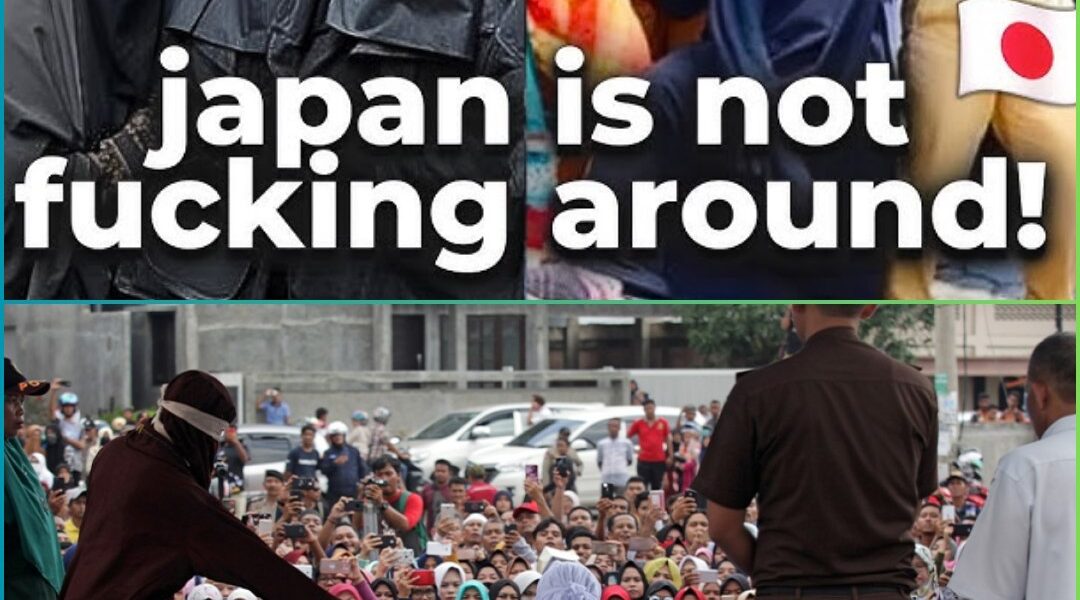

Japan, long regarded as a nation defined by social harmony, cultural consistency, and strict public etiquette, has recently found itself at the center of a heated online controversy.
A series of viral videos circulating across social media platforms claims to show foreign Muslim communities engaging in behavior that some commentators argue clashes with local norms.
These clips, widely shared and discussed, have triggered polarized reactions both inside and outside Japan, raising complex questions about integration, tolerance, and misinformation.
The footage in question depicts various scenes: individuals praying in public spaces such as train stations or retail areas, crowded religious gatherings, and confrontations between locals and foreign residents.
In one particularly widely circulated clip, a Japanese local politician is allegedly seen being physically confronted during a cultural event.
The incident has been framed by some commentators as evidence of rising tensions tied to immigration policies and cultural differences.
However, the narrative surrounding these videos is far from straightforward.
Experts caution that short, decontextualized clips can easily be used to promote misleading or exaggerated claims.
Japan has historically maintained relatively low levels of immigration compared to other developed nations, but in recent years, labor shortages have prompted the government to gradually open its doors to more foreign workers.
This shift has inevitably introduced new cultural dynamics into a society that has long emphasized uniformity.
Religious practices, particularly those requiring daily observance such as Islamic prayer, can present logistical challenges in countries where such needs are not widely accommodated.
Japan, with its limited number of mosques and prayer spaces, has seen some Muslims resort to praying in public or semi-private areas.
While some locals view this as a disruption to social norms, others see it as a practical response to a lack of infrastructure.

At the same time, there is little verified evidence to support sweeping claims about widespread disorder or criminal behavior among specific immigrant groups.
Analysts warn that such narratives often rely on selective examples, amplifying isolated incidents to suggest broader trends.
In fact, official data on crime rates among foreign residents in Japan remains a subject of careful interpretation, with authorities urging against generalizations.
The controversy has also highlighted the role of online influencers and commentators in shaping public perception.
Some videos include strong, emotionally charged language and sweeping statements about entire communities, which critics argue can fuel division and xenophobia.
Media literacy advocates stress the importance of verifying sources, understanding context, and avoiding conclusions based solely on viral content.
Meanwhile, voices within Japan itself remain diverse.
Some citizens express concern about preserving cultural identity and social order, emphasizing the importance of respecting local customs.
Others advocate for greater inclusivity and adaptation, arguing that Japan’s evolving demographic landscape requires a more flexible approach to multicultural coexistence.

Interviews with foreign residents paint a similarly nuanced picture.
Many describe positive experiences living and working in Japan, highlighting mutual respect and peaceful coexistence.
Some acknowledge challenges, including language barriers and cultural misunderstandings, but emphasize efforts to integrate and contribute to society.
The issue of public space usage is particularly sensitive in Japan, where unspoken rules govern behavior in shared environments.
Activities that might be considered normal elsewhere—such as loud gatherings or visible religious expression—can sometimes be perceived as disruptive.
This cultural context is essential for understanding why certain incidents, even if minor, can generate strong reactions.
At the heart of the debate lies a broader global question: how can societies balance cultural preservation with increasing diversity? Japan is not alone in facing this dilemma.
Countries around the world are grappling with similar tensions as migration reshapes communities and challenges traditional norms.

What makes the Japanese case unique is the country’s historical emphasis on homogeneity and its relatively recent encounter with large-scale immigration.
As policies continue to evolve, so too will public attitudes, shaped by both real-world interactions and the powerful influence of digital media.
Ultimately, the viral videos serve as a reminder of how quickly narratives can spread—and how easily they can oversimplify complex realities.
While they may capture moments of tension, they do not tell the full story of life in Japan today.
Understanding that story requires looking beyond the headlines, listening to multiple perspectives, and recognizing the human experiences behind the footage.
As the conversation continues, one thing remains clear: the future of multicultural coexistence in Japan will depend not only on policy decisions, but also on the willingness of individuals—both local and foreign—to engage with each other in good faith.