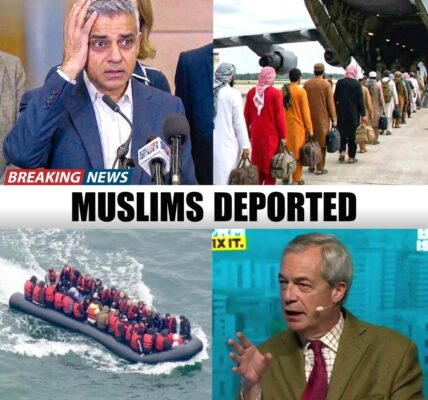
“£48,800 Per Migrant — And Still No Deterrent: Inside the Policy That’s Raising Questions About Britain’s Border Strategy Under Keir Starmer

In recent months, the United Kingdom’s approach to irregular migration across the English Channel has come under renewed scrutiny. What was once presented as a pragmatic deterrence mechanism—the so-called “one in, one out” arrangement—has increasingly become the subject of intense political and public debate.
At the center of the controversy is a simple but uncomfortable question: is the policy working?
The figures that have emerged suggest a troubling disconnect between intention and outcome. Since the early implementation phase, approximately 280 migrants have been returned to France under the scheme. In the same period, however, around 350 individuals have reportedly been sent from France to the UK under related arrangements. In purely numerical terms, the balance raises questions about the effectiveness of the policy’s core premise.

The financial cost has further intensified the debate. Estimates indicate that the UK is spending roughly £48,800 per migrant removed under the program. One widely cited case involved a chartered flight that returned 32 individuals at a total cost of approximately £1.52 million. For many observers, these figures have become symbolic of a broader concern: significant expenditure with limited measurable impact.
Crucially, the policy was designed with a clear objective—to act as a deterrent. The idea, as previously outlined by officials, was that migrants arriving via small boats would face immediate return, thereby discouraging future crossings. Yet, several months into the policy’s operation, the anticipated deterrent effect appears limited.
This assessment is not confined to political critics. Tony Smith, the former head of the UK Border Force, has publicly questioned whether the original “business case” for the policy still holds. According to Smith, while there may have been a slight reduction in crossings at certain points, the scale of change falls far short of what would justify the financial and operational costs involved.

One of the key structural challenges lies beyond the UK’s direct control. Reports suggest that migrants returned to France are often released shortly thereafter, with limited follow-up enforcement. In some cases, individuals are believed to attempt the journey again within days. This cycle—arrival, return, release, and reattempt—undermines the very concept of deterrence on which the policy depends.
From a policy perspective, this raises a deeper issue: deterrence strategies require not only immediate action but also sustained consequences. Without consistent enforcement on both sides of the Channel, the system risks becoming a repetitive loop rather than a meaningful barrier.
The operational dimension also presents complexities. Deportation flights require significant logistical coordination, including security measures for individuals assessed as high risk. In certain cases, restraints have been used during removal operations, highlighting the sensitive and sometimes controversial nature of enforcement practices.
Beyond the mechanics of the policy, the political implications are becoming increasingly significant. Under the leadership of Keir Starmer, the government has emphasized a commitment to restoring control, ensuring fairness, and delivering effective migration management. However, policies perceived as costly and ineffective can quickly become focal points for broader criticism regarding governance and strategic direction.

Public sentiment plays a crucial role in this dynamic. For many citizens, the issue is not only about border control but also about resource allocation. At a time when households are facing economic pressures, high-profile spending on policies that do not deliver clear results can erode trust and confidence.
At the same time, it is important to recognize the complexity of the migration challenge. Cross-channel crossings are influenced by a range of factors, including geopolitical instability, economic disparities, and international legal obligations. No single policy can fully address these underlying drivers.
Nevertheless, the effectiveness of individual measures remains a legitimate area of scrutiny. When a policy is introduced with a specific objective—such as deterrence—it is reasonable to evaluate whether that objective is being met.
Looking ahead, the UK government faces a critical decision point. It can continue refining the current approach, seek deeper cooperation with French authorities, or explore alternative strategies that address both immediate enforcement and longer-term structural issues.
What is clear is that the current trajectory has opened a wider conversation—one that extends beyond migration policy itself. It touches on questions of governance, accountability, and the balance between cost and outcome.
As that conversation evolves, the central issue remains unchanged: in a policy designed to deter, the absence of deterrence may be the most significant result of all.