Something massive is happening in the UK and Ireland! Citizens are stepping into a “policing vacuum,” taking matters into their own hands as neighborhoods reach a breaking point.

A series of intense, citizen-led interventions against alleged migrant-driven crime in the UK and Ireland has captured public attention, exposing deep fractures in the social contract. As locals increasingly take the law into their own hands, a fierce political debate is emerging over the effectiveness of the justice system and the weaponization of social labels in street-level conflicts.
The Escalation of Citizen Interventions In recent months, a deeply unsettling trend has emerged across various cities in the UK and Ireland, characterized by a growing wave of public frustration over property destruction and violent crime [00:04:00]. The core of this political firestorm stems from the public’s perception that certain individuals entering these host countries are disregarding the rule of law and exploiting a passive judicial system. As the state is perceived to be failing in its primary duty to protect citizens, local residents are increasingly stepping in to fill the policing vacuum .
The UK Confrontation: Frustration Boils Over A prime example of this escalating tension was recently documented in the UK, where a group of local men—described in the footage as “British patriots”—confronted a man accused of serial offenses in their neighborhood .
During the heated and expletive-laden altercation, residents accused the individual of willfully crashing into a local man’s van , engaging in arson by burning items outside a residential flat , and making severe threats, such as mimicking the slitting of a throat . The incident exposed a severe breakdown in community trust. The locals expressed deep anger that the man allegedly weaponized law enforcement by “ringing the plod” (calling the police) to protect himself, while simultaneously terrorizing the neighborhood .
The raw footage of the event illustrates a volatile environment where citizens, feeling that the formal justice system offers no deterrent, resort to aggressive physical intimidation to enforce their own boundaries and protect their properties .
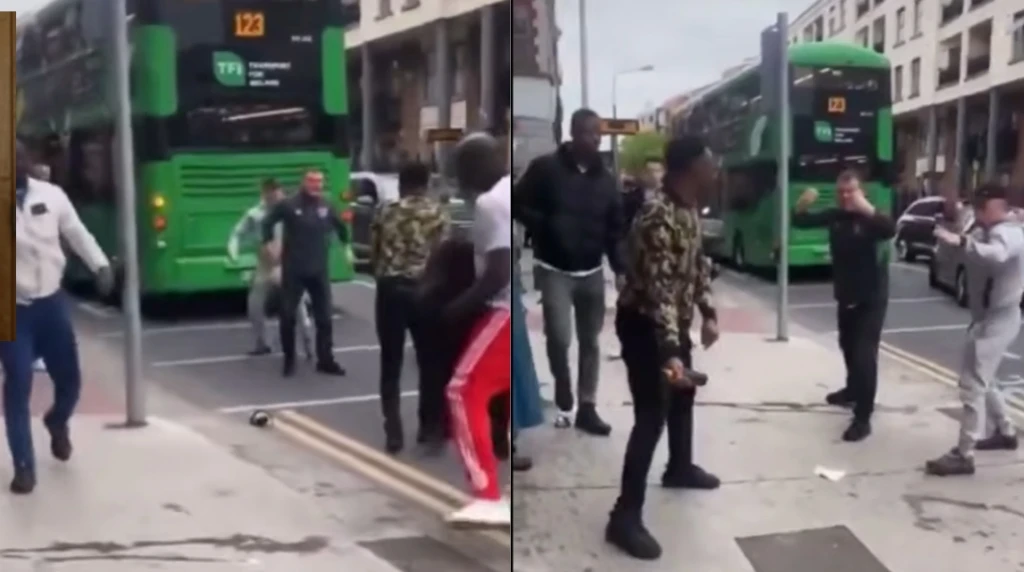
The Republic of Ireland: Street Brawls and Social Labels Simultaneously, the situation in the Republic of Ireland presents an even more volatile example of this breakdown in public order . Recent street footage highlights an incident where a group of individuals, identified as migrant thugs, allegedly launched an unprovoked physical attack on local pedestrians .
A highly controversial element of this confrontation was the attackers’ reported use of social labels. While physically assaulting the locals, the aggressors allegedly attempted to shut down resistance by shouting accusations of racism . Political commentators analyze this as a calculated tactic—weaponizing progressive social terminology to paralyze victims and bystanders with the fear of being labeled a racist, thereby overriding their natural instinct to defend themselves.
However, this tactic proved ineffective on the Irish streets. Local residents responded with a communal physical defense against the predatory behavior, leading to a street brawl that only dispersed once formal law enforcement arrived on the scene . The reliance on a physical street brawl to restore order has prompted serious public questions about why authorities only intervene after violence has already erupted.
Political Implications: “Subsidizing Chaos” These incidents are no longer confined to abstract policy debates; they have direct, physical consequences for ordinary people trying to live their lives . The overarching political critique emerging from these events is directed squarely at the justice system. Critics argue that when police and the judiciary allow repeat offenders to walk free and continue committing crimes, the state is effectively “subsidizing chaos”.
The narrative taking hold among frustrated communities is that civility is a reciprocal agreement. When newcomers allegedly engage in unprovoked attacks or property destruction, they forfeit the right to be viewed simply as misunderstood newcomers . In this context, community defense is increasingly framed by locals not as an act of hate or prejudice, but as an absolute necessity .
Conclusion: The Demand for Strict Accountability The recent clashes act as a flashing red light for the international community and policymakers. They reveal a grim reality on the sidewalks: when the law ceases to function as a shield for the innocent, citizens will inevitably become their own shield .
As tensions simmer, the call for a return to “common sense policing” and strict accountability is growing louder . Lawmakers and law enforcement are now forced to reckon with a critical question: Is this rise in citizen intervention a necessary response to a failing system, or the beginning of a dangerous descent into unchecked lawlessness? . The public order—and the foundation of a functional, free society—depends heavily on their answer.