Brits issued no nonsense ‘use them or lose them’ warning over Union Jack flags.T


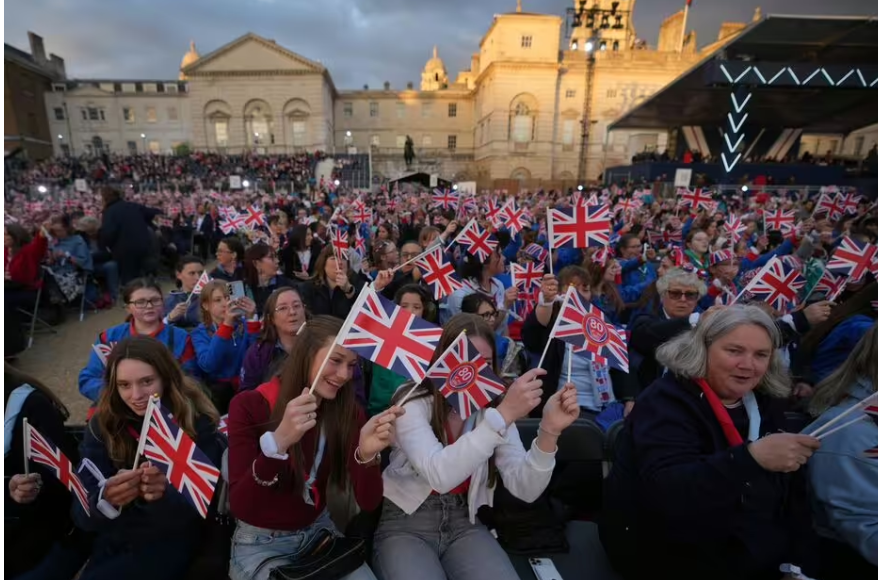
People wave flags before a concert to mark the 80th anniversary of VE Day in 2025 (Image: Getty Images)
A Royal Navy captain who helped to liberate the Falklands Islands from Argentina has said Britons must “use” the Union Jack flag to prevent extremists from reclaiming it. Captain Malcolm Farrow OBE, who served as a lieutenant commander under Task Force leader Admiral Sandy Woodward in 1982, said the government and public must both heed the “lesson” of the 1960s when the emerging National Front “hijacked” the flag.
His comments come as tensions soar across communities over the right to hoist Union Jack and St George’s flags – with councils increasingly divided over their approach. Only last week, south London resident David Gilley revealed he was ordered to remove a Union Jack flag from his balcony by Labour-run Southwark Council because it was deemed “offensive” to his neighbours.
But Capt Farrow, 81, a member of the Flag Institute Council and adviser to the all-party parliamentary group on British heritage, argues that it’s precisely when ordinary Britons don’t display patriotic flags proudly that extremists seize the opportunity to “hijack” them. He said: “If you don’t use it, you lose it. In the 1960s, we lost it to the National Front. They just picked it up and ran with it. It was a good idea of theirs, sadly.”

The current trouble emerged last summer when grassroots movement Operation Raise the Colours raised thousands of Union Jacks and St George’s flags on public lampposts, in a move welcomed by many but criticised by others as racist.
Councils have since spent over £115,000 to remove flags, according to the most recent data based on Freedom of Information requests.
Capt Farrow suggests Operation Raise the Colours is a British polite protest against the backlash to patriotic flag waving that effectively tells the government: “‘Hey, come on, look, we’ve had enough of all this. This is our flag and we’re proud of it, and start taking some note of us’.”
He added: “We don’t do what the French do, and have a mega riot. We make a stiff cup of tea and put a flag up. I like the idea, it makes people feel more patriotic and creates community cohesion and a sense of common purpose. That’s what a flag is for.”
Capt Farrow said the UK has “not traditionally been a very flaggy nation”. The Union Flag was initially used by Britain during her empire building, and principally by the monarch, the government and the armed forces instead of the common man.
He added: “Through this period of history, we were an homogenous nation. Most people were born and grew up, and lived and died in the same village. Everybody knew who everybody was. No one was invading us; we weren’t under threat.
“We didn’t have to gather around the flag and fight off the enemy. There was no imperative, no motivation to have a uniting flag. Why would you want to? Because we knew who we were.”
While Saint George’s Cross has been used as a symbol of England since the period of the Crusades – the religious wars arising in the Middle Ages – Capt Farrow says it was also never declared the national flag and was not usually flown on village greens.
He argues flag waving patriotism arrived after the end of World War One when Britons sought to join newly independent nations proudly displaying their flags across the globe.
Mr Farrow said: “People started asking, ‘What flags can we fly as citizens?’”

Captain Malcolm Farrow says all Britons should ‘use’ flags to prevent them being used by extremists (Image: SUPPLIED)
David Pritchard, senior lecturer in criminology and social policy at the University of Portsmouth, said the use of the Union Jack flag as an emblem for far-right political movements dates back to the post-war period – at least to the League of Empire Loyalists, which later became the National Front.
More recently the English Defence League has used variations of the Cross of St George in its protests, he added. But Pritchard emphasised that the flags are not intrinsically the symbols of the extreme right of politics.
He said: “The far-right’s use of the Union Flag and the Cross of St George are rooted in a mixture of nationalist symbolism, historical identity, and political messaging.
“The Union Flag and cross of St. George are not inherently far-right. They are national symbols used by people across the political spectrum. The issue arises when far-right groups co-opt them for exclusionary or extremist purposes, which can lead to tensions over their historical meaning and public perception.”
Three in five Britons want to see more flags flying in public spaces, according to a 2025 survey for think tank More in Common. Just under half – 49% – believed councils should only remove flags wherever they pose a safety risk, the same survey revealed.
The government has been contacted for a response.