Classic Civil War Portrait #41: George Custer Relaxing with His Dog and Camp Scene
Among the many surviving images of the American Civil War, there are a handful that rise above the rest—not only for their historical value, but for the quiet, human stories they capture within a single frame. Photograph #41 in this collection of classic Civil War images stands as one of those rare moments. At first glance, it may appear to be just another posed portrait of officers in camp. But upon closer inspection, the image reveals something deeper: a blend of formality and informality, discipline and leisure, history and personality—all centered around a young officer who would later become one of the most controversial figures in American military history, George Armstrong Custer.
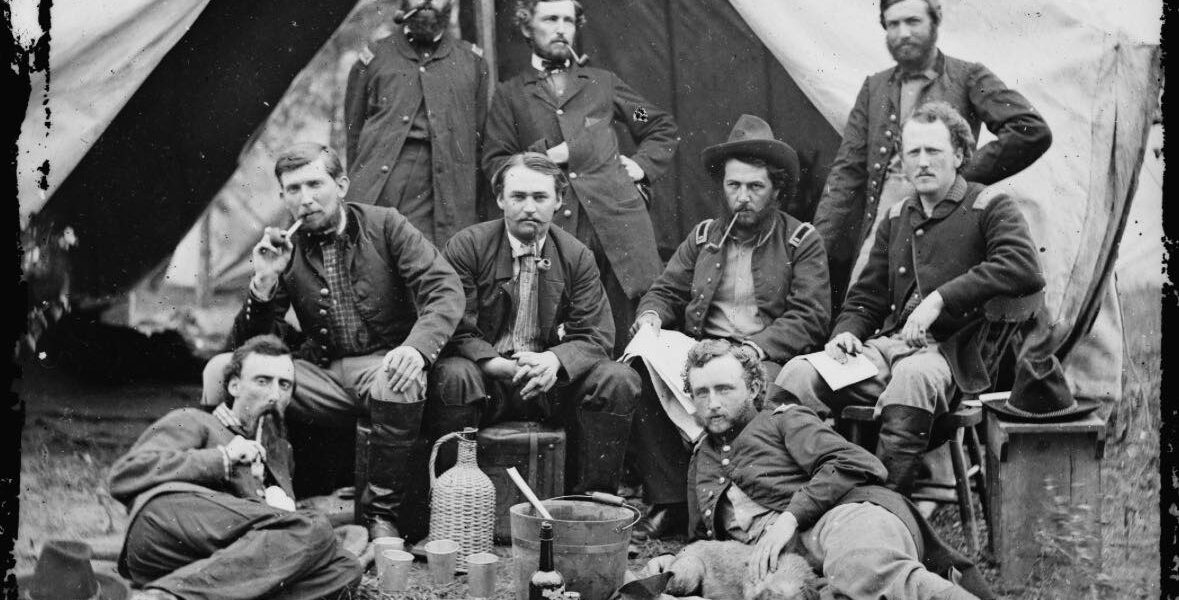
The composition of the photograph is immediately striking. Unlike rigid studio portraits of the era, this image unfolds in an outdoor camp setting. A tent stands in the background, slightly worn but sturdy, hinting at the temporary and ever-shifting nature of military life during the war. Scattered throughout the scene are everyday objects—a bucket, loose papers, and what appear to be supplies or personal belongings—creating a lived-in atmosphere that feels authentic rather than staged. These elements ground the image in reality, offering viewers a glimpse into the daily routines of officers during campaign life.
At the center of the composition is Custer himself, reclining casually on the ground. This pose alone sets the photograph apart. In an era where military portraits were often defined by rigid posture and stern expressions, Custer’s relaxed position suggests a level of confidence, perhaps even a hint of youthful arrogance. He does not stand at attention or sit upright like many of his contemporaries. Instead, he lounges, seemingly at ease, as if the war momentarily exists outside the frame. His body language conveys a sense of familiarity with both the environment and the people around him, as though he belongs naturally to this space of organized chaos.
Beside him lies a dog—an often overlooked but deeply meaningful detail. Animals in Civil War photographs were not uncommon, but their presence always adds a layer of humanity to otherwise formal images. The dog in this portrait appears calm, comfortable, and at home among the soldiers. Its inclusion softens the scene, reminding viewers that even in times of war, companionship and small comforts persisted. For Custer, the dog may have been more than just a camp animal; it could have represented a connection to normalcy in an otherwise turbulent world.
Other figures in the photograph contribute to its dynamic quality. Officers are arranged in relaxed poses, some seated, some leaning, others engaged in small, quiet actions—perhaps smoking or handling papers. The presence of cigarettes or cigars, along with drinks ready at hand, suggests a moment of pause rather than preparation for battle. This is not a scene of urgency or conflict; instead, it captures the in-between moments—the waiting, the resting, the living that happens amid the larger narrative of war.
What makes this image particularly compelling is the balance it strikes between authenticity and composition. While it may have been partially staged, it does not feel artificial. The arrangement of objects and people appears natural, as though the photographer simply stepped into the camp and captured a moment as it unfolded. This quality gives the photograph a timeless appeal. It allows modern viewers to connect with the subjects not just as historical figures, but as individuals experiencing a shared moment in time.
The photograph is often used in discussions of Civil War officers on campaign, and for good reason. It encapsulates many aspects of their daily lives—the blend of duty and downtime, the reliance on simple comforts, and the camaraderie among men facing uncertain futures. Yet, the image is also frequently singled out because of Custer himself. At the time the photograph was taken, he was a young officer, not yet the widely recognized figure he would become. His later career, particularly his role in the Battle of the Little Bighorn, would cement his place in American history, though not without controversy.
This hindsight adds another layer of meaning to the photograph. Knowing what lies ahead for Custer, viewers cannot help but read into his relaxed posture and confident demeanor. Is this the calm before a storm? A fleeting moment of peace before a life marked by bold decisions and dramatic outcomes? The photograph does not answer these questions, but it invites them, encouraging deeper reflection on the nature of history and how we interpret it through images.
The technical aspects of the photograph are also worth noting. Civil War photography relied heavily on large-format cameras and glass plate negatives, which required careful preparation and long exposure times. This meant that subjects often had to remain still for several seconds, if not longer. The clarity and detail in this image suggest a skilled photographer who understood both the technical challenges and the artistic possibilities of the medium. The high-resolution plates mentioned in the original post further enhance the experience, allowing viewers to examine fine details—the textures of uniforms, the expressions on faces, the subtle interplay of light and shadow.
Light plays a crucial role in the photograph’s overall effect. Natural daylight illuminates the scene, casting soft shadows and highlighting the contours of the subjects and their surroundings. This creates a sense of depth and dimension that draws the viewer into the image. The tent fabric, the ground beneath the officers, and even the fur of the dog are rendered with remarkable clarity, contributing to the photograph’s immersive quality.
Beyond its visual and historical significance, the image resonates on a more emotional level. It captures a moment of stillness in the midst of one of the most turbulent periods in American history. The Civil War was defined by its scale and its consequences, but it was also made up of countless individual experiences—moments of fear, courage, boredom, and connection. This photograph offers a window into one such moment, reminding us that history is not just a series of events, but a collection of human stories.
In modern times, the photograph continues to circulate widely, often shared in collections of iconic Civil War images. Its appeal lies not only in its subject matter, but in its ability to evoke curiosity and conversation. Viewers are drawn to the relaxed poses, the presence of the dog, and the contrast between the ordinary details of camp life and the extraordinary context of war. For some, it serves as an entry point into learning more about the Civil War and its figures. For others, it is simply a captivating image that invites repeated viewing.
The enduring popularity of this photograph also speaks to the power of visual storytelling. In a single frame, it captures a narrative that might otherwise require pages of text to describe. It shows us who these men were, how they lived, and how they chose to present themselves to the camera. It bridges the gap between past and present, allowing us to see history not as something distant and abstract, but as something tangible and relatable.
As we reflect on this image, it is worth considering what it represents beyond its immediate context. It is a reminder of the importance of preserving historical artifacts and the stories they carry. It highlights the role of photography in shaping our understanding of the past. And perhaps most importantly, it underscores the complexity of history itself—the way it is composed of both grand narratives and quiet moments, of famous figures and everyday experiences.
In the end, Photograph #41 is more than just a “classic” image. It is a layered, multifaceted piece of history that continues to reveal new insights with each viewing. Whether one is drawn to it because of George Custer, the composition, or the glimpse it offers into Civil War life, there is no denying its impact. It stands as a testament to the enduring power of images to capture not just what happened, but what it felt like to be there.
And in that sense, it achieves something truly remarkable: it brings us closer to a moment in time that, while long past, still resonates with meaning today.