“Cosa accadde davvero alle iconiche jeep militari americane dopo la Seconda guerra mondiale.” hyn

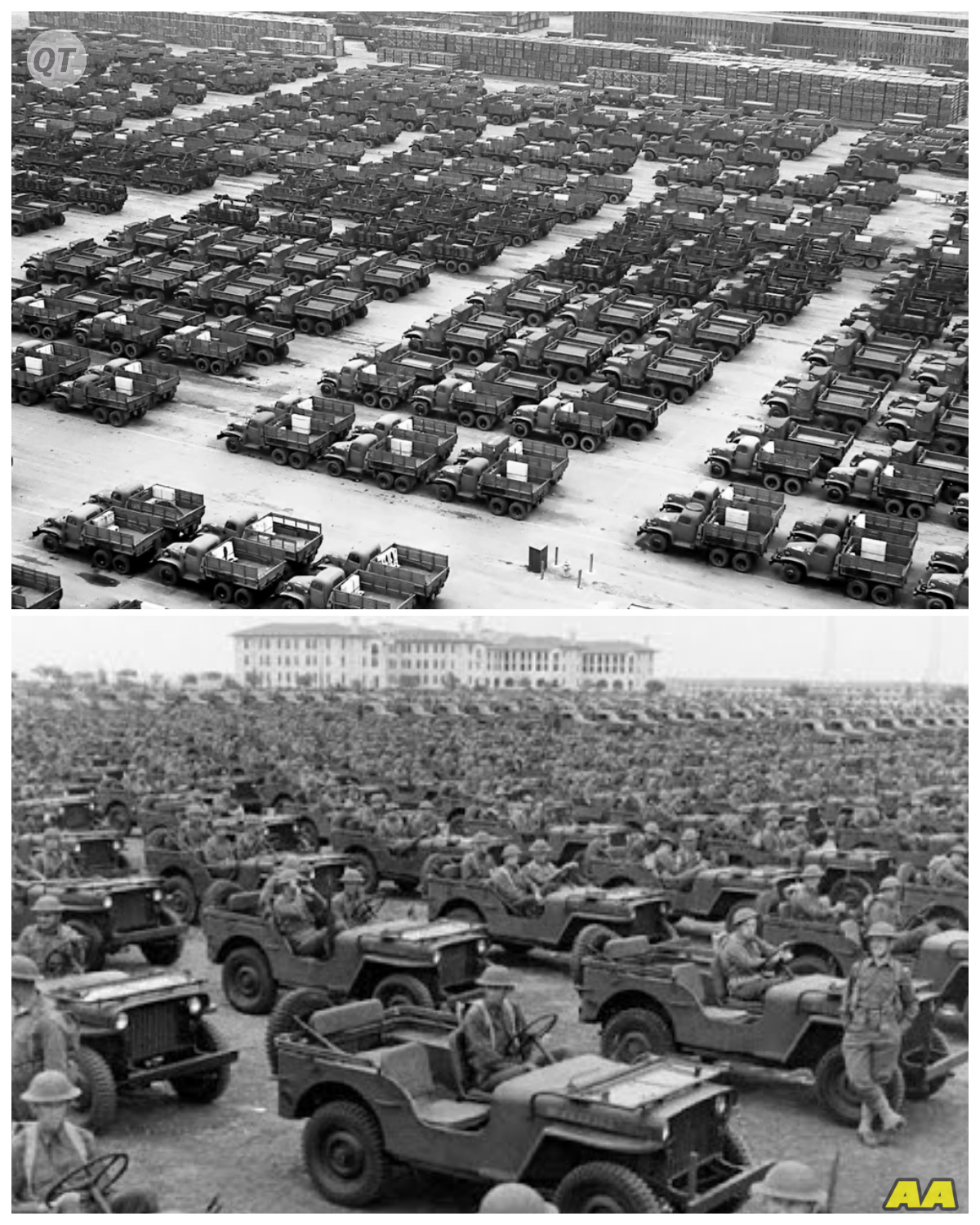
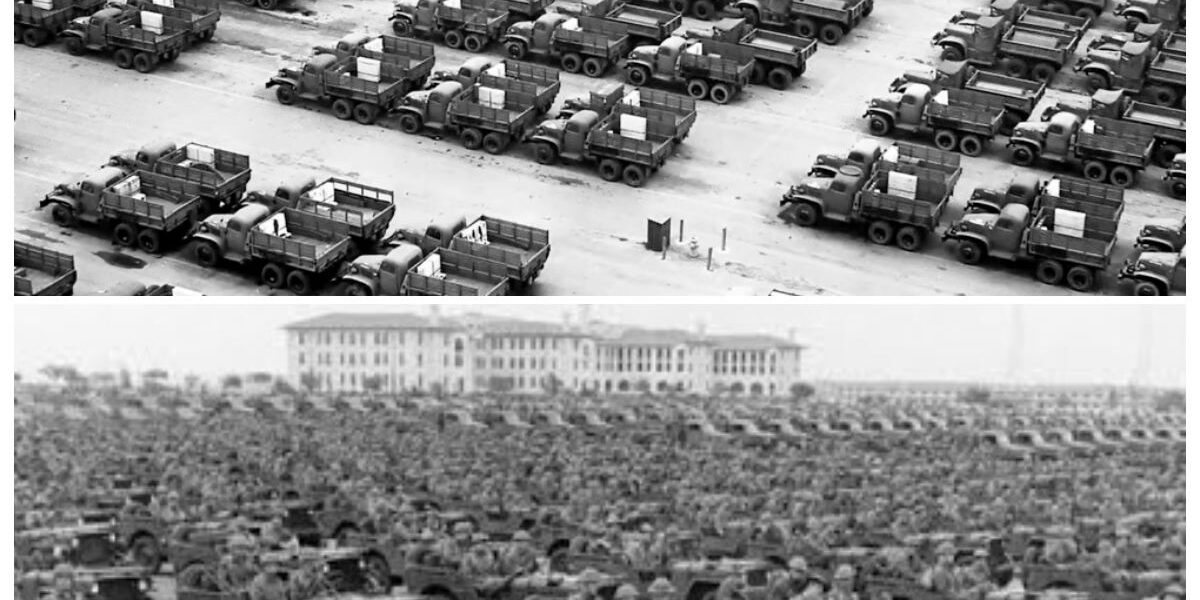
Across the Pacific, from the Philippines to Okinawa, from airfields in France to supply depots in Germany, hundreds of thousands of American jeeps sit in precisely organized rows.
Their olive drab paint already faded from years of hard service.
These small, rugged vehicles carried generals and privates alike.
They hauled ammunition through the deserts of North Africa, crossed the beaches of Normandy, and threaded their way through the jungles of Burma.
General George Marshall called the Jeep America’s greatest contribution to modern warfare.
Eisenhower ranked it among the five most vital pieces of equipment for victory.
Now, with victory secured and millions of soldiers desperate to go home, these machines present an extraordinary problem.
Nearly 650,000 jeeps were built during the war.
What happens to them when the fighting stops? The answers would reveal everything from calculated destruction to ingenious reinvention.
From the birth of an American icon to the creation of entirely new transportation cultures on the other side of the world.
This is what happened to America’s legendary Jeeps after World War II.
The scale of Jeep production during the war remains staggering even today.
Between 1941 and 1945, Willies Overland and Ford Motor Company manufactured approximately 648,000 vehicles.
Willies built over 360,000 of their MB model, while Ford contributed roughly 280,000 GPW versions.
The vehicles served in every theater of operations from the frozen mountains of Italy to the sweltering islands of the Pacific.
Each infantry regiment had an average of 145 jeeps assigned to it.
They served as reconnaissance vehicles, command cars, ambulances, weapons platforms, and supply haulers.
Soldiers modified them endlessly, mounting machine guns, stretching their frames, adapting them for radio communications, even fitting them with railroad wheels to run on captured enemy tracks.
By May 1945, these vehicles were scattered across the globe.
Tens of thousands remained in Europe with the occupation forces.
Others sat on islands throughout the Pacific, many barely accessible.
Still more were stored at depots across the continental United States awaiting disposal.
The United States government faced a question that had no precedent.
How do you process the largest single fleet of military vehicles ever assembled? The War Assets Administration was established to handle this mammoth task.
Created in March 1946, this organization inherited responsibility for disposing of billions of dollars worth of surplus military equipment, and the Jeep was among the most desirable items on the list.
Veterans returning home had spent years watching these incredible little vehicles tackle battlefields around the world.
They knew what a Jeep could do, and they wanted one.
In late October 1945, the government put the first 9,100 quarterton army trucks up for sale.
Federal agencies, state governments, and taxup supported institutions got first priority.
Veterans came next, followed finally by civilians.
Prices were set at depreciated but still substantial rates.
The government sold surplus Jeeps for approximately $975 each, the equivalent of over $16,000 today.
These were not cheap vehicles, and they were not in pristine condition.
Many had seen combat.
Some had been driven across half of Europe or through the mud of a dozen Pacific islands.
The demand was extraordinary.
At the Benicia Arsenal in California, over 10,000 veterans showed up in June 1946 to bid on approximately 1600 available jeeps.
The line wound through the base and stretched more than a mile into the surrounding town.
Some buyers had arrived the night before, sleeping in line to ensure their place.
Similar scenes played out at Port Huami, where nearly 5,500 vehicles valued at $14 million were put up for auction exclusively to veterans.
Yet, for every Jeep that found a new owner, many more met a different fate entirely.
The logistics of returning vehicles from overseas proved impossibly expensive in many cases.
Shipping costs often exceeded the vehicle’s value.
Local commanders pressured to wrap up operations and bring troops home were given authority to dispose of equipment as they saw fit.
What followed was destruction on a scale that seems almost incomprehensible today.
In the Philippines, soldiers pushed hundreds of jeeps off peers into the ocean using bulldozers.
One veteran recalled how his unit offered free jeeps to any servicemen willing to pay shipping costs back to the United States.
Almost no one took the offer.
The paperwork was too complicated, the expense too uncertain.
So the jeeps went over the side, disappearing beneath the waves.
In the Northern Territory of Australia, American crews drove Jeeps into remote semi-jungle areas, drained the engine oil, and left the vehicles running with bricks on the accelerators until they seized and died.
It was faster than paperwork.
Perhaps the most dramatic example occurred at Espiritu Santo, an island in the Vanuatu Archipelago.
There, at a site now called Milliondoll Point, American forces disposed of equipment worth millions of dollars, they built a massive ramp running directly into the sea.
Day after day, CBS drove trucks, jeeps, bulldozers, ambulances, and tractors down that ramp and into the channel, never to be seen again.
Travel writer Thirsten Clark recorded that watching these marvels of engineering driven deliberately into the water brought some of the seabbees to tears.
Locals witnessed what seemed like an act of pure madness.
The site became a popular diving destination with divers today reporting jeeps, six- wheeled trucks, bulldozers, forklifts, and even cases of Coca-Cola resting on the ocean floor.
The British and French authorities on the island had refused to pay for the surplus equipment, hoping the Americans would simply abandon it.
Instead, the United States military chose destruction over leaving useful material behind for free.
It was a decision driven by a mix of logistics, economics, and policy.
But not every jeep was destroyed.
In the Philippines, something remarkable happened to many of the vehicles that survived.
Filipinos acquired surplus jeeps through sales, gifts, and less official channels.
The country’s transportation infrastructure had been devastated by war and roads were in ruins.
Rather than letting these vehicles rust away, local mechanics saw potential.
They stripped down the jeeps, extended their frames, added metal roofs for shade, and installed benches in the back to carry multiple passengers.
They decorated these transformed vehicles with vibrant colors, chrome plating, hood ornaments, and elaborate painted scenes.
The Jeep was born.
These stretched decorated vehicles became the backbone of Philippine public transportation.
They could carry 12 to 25 passengers at affordable fairs running fixed routes through Manila and cities across the archipelago.
Each jeepney became a canvas for personal expression featuring religious imagery, family portraits, movie characters, and basketball stars.
The phrase king of the road became synonymous with these vehicles.
Families built businesses around operating jeepnes, passing down routes and vehicles from fathers to sons across generations.
The jeepn represents one of the most creative acts of post-war recycling in history.
An American military vehicle designed for war became a Filipino cultural icon that endures to this day.
Meanwhile, back in the United States, Willies Overland had been planning for peace since 1942.
The company recognized that returning veterans would have forged a bond with their jeeps on the battlefields, and they intended to leverage that relationship into civilian sales.
In July 1945, even before the war ended, Willies launched the CJ2A, the first mass-produced civilian jeep.
The CJ stood for civilian jeep.
The company targeted farmers specifically.
According to Willys, there were 5 12 million farmers in the United States, and more than 4 million of them owned neither a truck nor a tractor.
The CJ2A was marketed as the all-around farm workhorse, capable of doing the job of two draft horses at 4 mph, 10 hours a day without overheating.
Willies offered an array of agricultural accessories, rear hydraulic lifts, power takeoff units, snow plows, welders, generators, mowers, and disc harrows.
The Jeep could plow fields in the morning and drive the family to church on Sunday.
Sales were brisk despite the flood of surplus military jeeps available.
Popular Science magazine ran a contest offering cash prizes for ideas on peaceime jobs for jeeps, stimulating American ingenuity.
Soon jeeps were being used for everything imaginable.
From 1949 to 1964, every Zamboni ice resurfacing machine used either a complete jeep or a jeep chassis as its base.
The Zamboni Model A using Jeep mechanics could resurface an ice rink in 10 minutes, a job that previously took over 90 minutes by hand.
The civilian Jeep line expanded rapidly.
The Jeep station wagon arrived in 1946, the first vehicle to feature all steel construction in a wagon format.
The Jeep Truck followed in 1947, marketed to farmers with the tagline all truck all over.
The Jeepster appeared in 1948.
Designer Brooks Stevens vision of an open top American sports car promoted as suitable for women drivers and college graduates.
By 1949, Willies had sold nearly a quarter million civilian Jeeps and earned over 142 million.
The military, meanwhile, was not finished with the Jeep.
When the Korean War erupted in June 1950, the United States armed forces needed vehicles fast.
Willies had already been developing an updated version of the wartime MB, incorporating lessons learned from Pacific theater operations where water crossings proved challenging.
The result was the M38, which entered production in September 1950.
The M38 was essentially a militarized version of the civilian CJ3A with significant upgrades.
It featured a reinforced frame, waterproof 24volt electrical system, and sealed ventilation for the engine, transmission, and fuel system that allowed the vehicle to ford rivers up to 6 ft deep.
The familiar Goevil engine remained, providing reliable low-end torque across Korea’s mountainous terrain.
Over 60,000 M38s were manufactured between 1950 and 1952, though many Jeeps serving in Korea were actually remanufactured World War II vehicles given new life in military workshops.
The M38 assumed many combat and support roles along the 38th parallel.
In October 1950, the Jeep led the strategic withdrawal when Chinese forces entered the war.
One surviving M38, now meticulously restored, still bears three bullet holes from its service with an atomic support unit responsible for the massive howitzer nicknamed Atomic Annie.
The vehicle traveled from Korea to France, had its engine rebuilt there, and eventually returned to the United States decades later.
The M38 and its successor, the M3801, with its distinctive round fenders continued in military service through the early 1970s before the Ford M151 replaced them.
Across the Atlantic, the Jeep story took another remarkable turn.
After the war, the United States had presented France with 22,000 surplus Willies MBS and Ford GPWs to help the country rapidly rebuild its military capabilities.
Only about half were in usable condition.
French engineers at the ERGM facility in Maltou, a Paris suburb, began the painstaking work of rebuilding these vehicles, cannibalizing damaged Jeeps for spare parts to make others operational.
When spare parts began running low, the French company Hotkiss, which had been manufacturing replacement components, secured a license from Willys to build complete Jeeps.
Beginning in 1955, Hutchkis produced the M201, essentially identical to the American wartime design with minor improvements.
A thicker gauge chassis, reinforced radiator, timing gears instead of chain drive, and electrical systems modified to NATO 24V specifications.
By 1966, Hotchkiss had manufactured 27,628 M201 jeeps, mostly at a plant in Stains, north of Paris.
The French military used them extensively, developing a special Sahara version with strengthened suspension and a second fuel tank for operations in North Africa and Algeria.
The M201 served in French military operations from Indochina to Zire to Chad.
The French Foreign Legion used them in reconnaissance and liaison missions across the globe.
The last Hutchkiss M201 was retired from French military service in the year 2000, 55 years after the original design had first rolled off American assembly lines.
In France, these vehicles never required a complicated name.
They were simply called the jeep.
Other nations received jeeps under lend lease agreements and kept them in service for decades.
Britain, Canada, Australia, the Soviet Union, China, and many other countries operated American jeeps during and after the war.
Canada produced its own versions with Ford of Canada assembling approximately 2300 M38 CDN jeeps for the Canadian Armed Forces.
South Korea produced local versions of the M3801 that entered service in 1978 and were even exported to countries like Bangladesh, Chad, Iran, and Lebanon.
The myth of the $50 Jeep became one of the most persistent legends of the post-war era.
Magazine advertisements in the 1940s and 1950s promised army surplus jeeps for incredibly low prices.
For just $20, they claimed you could receive information on how to bid at government auctions.
The reality was far more prosaic.
These were scams.
The pamphlets contained freely available government information.
No crated pristine jeeps were ever sold for $50.
The actual surplus vehicles cost nearly $1,000 had been used in combat and were sold through controlled government auctions with veterans given priority.
The legend of the jeep in a crate proved equally persistent and equally false.
Stories circulated of brand new Jeeps still protected in thick cosmoline available for purchase in their original shipping crates.
No such Jeep has ever been verified.
Dealers have offered substantial rewards for anyone who can produce a legitimate crated jeep.
No money has changed hands.
While the army did occasionally crate jeeps for overseas shipment, it was an expensive process reserved for when absolutely necessary.
Any that might have existed were long since opened and used.
Today, the surviving original jeeps from World War II have become prized collector’s items.
Museums across America display restored examples from the National World War II Museum in New Orleans to private collections throughout the country.
Military vehicle collectors seek out surviving MBs and GPWs, restoring them to running condition.
Shows and rallies draw enthusiasts who appreciate both the historical significance and mechanical simplicity of these vehicles.
The legacy extends far beyond collectibles.
The modern Jeep Wrangler, still in production today, maintains the essential character of the original design.
The distinctive seven slot grill, the flat fenders, the upright windshield, the rugged off-road capability.
According to Jeep, over 5 million Wranglers have been sold since 1987 alone.
The Wrangler remains America’s best-selling plug-in hybrid, outselling even the resurgent Ford Bronco.
Four-wheel drive, once an exotic military feature, became a household concept directly because of the Jeep’s success.
The story of the postwar Jeep encompasses almost every possible fate for military surplus.
Hundreds of thousands were destroyed, pushed into the ocean, driven into remote wilderness, or scrapped for their metal.
Tens of thousands were sold to eager veterans and civilians who put them to work on farms, ranches, and construction sites across America.
Thousands more were given to allies who operated them for decades or built their own versions under license.
Some spawned entirely new forms of transportation like the Philippine Jeepnney.
Others became museum pieces, their olive drab paint carefully preserved for future generations.
What survives today represents perhaps less than 1% of the original production.
The vast majority simply vanished, consumed by rust, recycled into other products, or resting on ocean floors from the Philippines to Vanuatu.
Yet, the Jeep’s influence proved more durable than any individual vehicle.
Its simple, rugged design philosophy shaped military thinking and civilian expectations for decades.
Its success demonstrated that a utilitarian machine could become beloved, that practicality and personality were not opposites.
The men who built those original jeeps in Toledo, Ohio, working around the clock during the war years, could not have imagined their creation serving French paratroopers in Africa, carrying Filipino families through Manila streets, or inspiring vehicles still in production eight decades later.
The Jeep that emerged from World War II was more than a vehicle.
It became an idea, a template, a foundation for everything that followed.
The story that began on American factory floors ended up scattered across the globe, above water and below, from museums to junkyards to dive sites to the streets of modern cities.
And in that scattering, the Jeep achieved something its designers never intended.
It became truly universal.
If you found this video insightful, watch what happened to Germany’s Luftwaffer planes after World War II next.
It explores how the captured aircraft were studied, redistributed, and systematically destroyed in the aftermath of the war.
Like this video, subscribe, and hit the bell for more History Inside.
Thanks for watching.