

They were just ordinary women.
But
inside Stutthof concentration camp, they became something else.
Wearing simple SS
uniforms, they carried out acts of brutal violence with disturbing ease.
Some dragged women by the
hair.
Others smiled while selecting children for the gas chamber.
When the war ended, they thought
they’d disappear into the crowd.
But history had other plans.
What followed was one of the most
shocking public reckonings of the entire war.
It began just one day after Nazi Germany
invaded Poland.
On September 2, 1939, the very first Nazi concentration camp outside
German borders was established near the city of Danzig, now called Gdańsk, in modern-day
Poland.
This place was called Stutthof, and it would soon become one of the most
brutal and horrifying camps of the entire war.
At the beginning, it was only a small facility
designed to imprison Polish intellectuals, political enemies, teachers, priests,
and anyone seen as a threat to Nazi control over the newly invaded territory.
But Stutthof didn’t stay small for long.
As the war dragged on, the camp grew
rapidly, both in size and in purpose.
What started as a small prison camp turned
into a major killing center.
Over time, it was surrounded by barbed wire, watchtowers,
and dozens of wooden barracks.
It expanded to include thirty-nine subcamps spread across
the region, and its prisoner population became more diverse and more targeted.
Jews from
across Europe began arriving in large numbers, especially in the later years of the war.
So did Soviet prisoners of war, Roma people, and others labeled as enemies of the Nazi state.
By the time World War II came to an end in 1945, more than 110,000 people had been imprisoned
in Stutthof.
Of that number, at least 65,000 were killed, either by starvation, disease,
forced labor, beatings, execution, or gassing.
Stutthof had everything a death camp
needed.
It had a gas chamber, built in 1943, capable of killing dozens of people at once.
It had a crematorium to burn the bodies.
It had barracks where prisoners were crammed together
with almost no food, no hygiene, and no chance of survival.
Typhus and dysentery spread fast.
Guards were known to beat prisoners for no reason, force them to work until they collapsed, or march
them out into the cold to die slowly.
The camp was cruel by design, and those who ran it wanted
people to suffer every moment they were alive.
But what made Stutthof even more disturbing
was the active role of female guards.
These weren’t just secretaries or nurses.
Many
of them were trained to be just as harsh and violent as the SS men.
They carried weapons,
barked orders, and punished prisoners directly.
What happened inside Stutthof set the stage for
what would come after the war.
When the world finally saw the crimes that took place in this
camp, especially the crimes committed by women, it caused shock, outrage, and a demand for
justice.
But justice wouldn’t come right away.
First, the war had to end.
Then,
the hunt for the guards would begin.
The reason for choosing women was the expansion
of the Nazi system.
It had grown too big for just men to control.
As more Jews, Poles, and other
targeted groups were deported to camps, the SS found themselves short on staff.
They turned
to women, ordinary women from across Germany and occupied countries.
These weren’t trained
soldiers.
Most had never even held a weapon before.
They were young, sometimes barely in
their twenties.
Many came from rural backgrounds.
Some were secretaries, nurses, or just women
looking for steady work during the chaos of war.
But once they joined, everything changed.
They went through short, intense training at Ravensbrück or directly inside the camps.
They were taught how to control prisoners, how to use dogs, and how to maintain “order” through
violence.
Their new title was Aufseherin, which meant female overseer.
It sounded like a
simple job, but it gave them terrifying power.
At Stutthof, around 30 of these women became
part of the camp system.
Their main duty was controlling the women’s section of the camp,
which grew rapidly in the final years of the war.
They carried whips, sticks, and
sometimes even pistols.
They yelled, insulted, kicked, and slapped prisoners
daily, often for no reason at all.
If someone stumbled from weakness or hunger,
the guards didn’t help.
They punished.
Many of these women grew more brutal with time.
Some took satisfaction in deciding who would be sent to forced labor and who would be killed.
They
had the power to point at a sick or weak prisoner, and that one gesture could mean death in the gas
chamber.
They weren’t just assistants to male SS officers.
In many cases, they acted independently
and made life-or-death choices on their own.
One of the main guards was Jenny-Wanda Barkmann.
She may have entered the world of fashion, but she exited it in a uniform of death.
Born in
Hamburg in 1922, she once walked city streets as a model, praised for her looks and charm.
But when she arrived at Stutthof in 1944, that elegance turned into something terrifying.
She was assigned to oversee selections, where thousands of women and children were chosen
for the gas chamber.
Barkmann didn’t hesitate.
She was known to stroll the campgrounds with a whip
in her hand, using it on the weakest inmates.
Survivors recalled the cold precision with which
she performed her duties.
She wasn’t just another uniform; she became a symbol of beauty fused with
brutality.
Despite having no military training, she embraced her new power.
It was said
that even some male guards were shocked by her confidence during executions.
Her
transformation wasn’t one of ignorance; it was intentional.
She saw the death,
and she chose to be a part of it.
Another guard, Ewa Paradies, had once
been responsible for educating children.
As a schoolteacher born in 1920, her job had
been to guide the young, instill discipline, and provide safety.
But in Nazi Germany,
education meant something else.
When she joined the SS Women’s Auxiliary Corps and was assigned to
Stutthof, she abandoned all traces of that former life.
Witnesses described her as unpredictable and
cruel, often dragging emaciated women by the hair, shoving them to the ground, or beating them
with sticks.
Her violence was not occasional; it was routine.
Prisoners said she seemed
to delight in humiliating the sick.
She didn’t just lose her empathy;
she replaced it with aggression.
Similarly, Elisabeth Becker had no background
in law, politics, or policing.
She worked at a cinema before the war, a setting filled with
stories and fiction.
But when she arrived at Stutthof in late 1944, she stepped into a
nightmare that was all too real.
She had no training in punishment or control, yet she
adapted immediately.
Within weeks, she was enforcing camp rules and escorting prisoners to
selections.
Her five months at Stutthof overlapped with the mass extermination of Jews deported
from the Baltics.
Despite the short duration, multiple survivors recognized her, recalling
how she stood silently as people were chosen for death.
She didn’t scream or boast like
some others, but her quiet presence during the killings made her complicity unmistakable.
The
ease with which she slipped into the machinery of death showed how ordinary people could
quickly turn into instruments of genocide.
Gerda Steinhoff had worked in homes, cared for
children, and lived an unremarkable life before the war.
Born in 1922, she entered the Nazi system
with no record of violence.
But something changed in her, too, when she joined the SS.
At Stutthof,
she quickly rose to become a camp overseer.
That position gave her power over hundreds
of lives.
According to survivor accounts, Steinhoff was one of the most feared women in
the camp.
Her selections were carried out with chilling calmness, and she often smiled
while picking out victims.
Some witnesses said she carried a riding crop and used it on
prisoners who moved too slowly or spoke out of turn.
She didn’t just carry out her duties;
she asserted her authority with satisfaction.
In the final months of the war, when the pace
of killings increased, Steinhoff became even more active.
Her rise through the ranks
reflected not just obedience but ambition.
Wanda Klaff had never been in the military.
She
worked at a jam factory, then married and became a housewife.
But after joining the SS auxiliary
services, her life took a dark turn.
Klaff wasn’t hesitant or uncertain when she entered Stutthof;
she was aggressive.
Known for her sharp voice and fast temper, she lashed out at prisoners without
provocation.
During trials, witnesses remembered her as one of the loudest and most violent female
guards.
She would strike prisoners with wooden sticks or whatever was at hand.
Her own words
during her trial showed no remorse; she claimed she was tougher than most men.
She didn’t just
enforce orders; she personalized her violence.
Her brief time at the camp left a deep mark on
those who survived her wrath.
Like others, she was not selected for her skills; she was chosen
because she could follow orders without mercy.
These weren’t victims of circumstance.
They
weren’t forced to commit atrocities.
They volunteered.
They followed orders, and sometimes, they went beyond them.
They took power when it
was offered.
But justice would catch up soon.
When Nazi Germany collapsed in May 1945,
the world was forced to confront the full horror of what had happened behind the
barbed wire fences of concentration camps.
Allied soldiers arrived to find piles of
unburied corpses, half-dead prisoners, and rooms that still reeked of human suffering.
Photographs taken inside the camps showed emaciated bodies stacked like firewood.
Survivors shared stories of forced labor, beatings, medical experiments, and gas chambers.
It wasn’t just war; it was industrialized murder.
Public outrage exploded across Europe
and beyond.
The Allied powers, along with governments like Poland’s, moved quickly
to identify and arrest those responsible.
The goal wasn’t just to capture the high-ranking
architects like Hitler or Himmler, some of whom were already dead, but also the ones who had
carried out the daily cruelty.
The guards.
The executioners.
The ones who stood watch while
people were starved, tortured, and killed.
Former SS officers and camp workers tried
to disappear.
Some shaved their heads, burned their uniforms, or changed their
names.
Others hid in nearby villages, hoping the chaos of postwar Europe would shield
them.
But witnesses remembered faces.
Survivors recognized voices.
By 1946, the manhunt
was well underway.
Hundreds of guards, male and female, were found,
arrested, and sent to face justice.
Now it was time to hold them accountable,
not just in memory, but in court.
The First Stutthof Trial opened on April 25,
1946, in the Polish city of Gdańsk.
Thirteen former staff members from the concentration camp,
both men and women, were brought before the court, charged with crimes against humanity.
Among them
were five female guards who had become infamous for their brutality, including Jenny-Wanda
Barkmann, Ewa Paradies, Elisabeth Becker, Gerda Steinhoff, and Wanda Klaff.
Their
names were already known to survivors and investigators alike.
Each had played a direct
role in selections for the gas chambers, in beatings, in humiliations, and in the daily
terror that defined life inside Stutthof.
For the first time, the world was seeing
not just male officers, but women being held accountable for mass murder.
In court,
they no longer wore their crisp SS uniforms.
They sat in plain civilian clothes,
with pale faces and quiet demeanors, stripped of the authority they once
used to control life and death.
But their crimes were impossible to hide.
Witness after witness came forward.
Survivors pointed them out in the courtroom and
recounted the horrors they had suffered at their hands.
The evidence was overwhelming.
The trial was more than just legal proceedings; it was a historic moment of reckoning.
The
myth that only men could be monsters was being shattered.
These women had proven otherwise.
Each woman had her story told, not from her mouth, but from the people who lived through her abuse.
And when the trial ended, the court had no doubts.
On May 31, 1946, the court delivered its
judgment.
Of the thirteen defendants, nine were sentenced to death by hanging.
Every one of
the five female guards was among them.
The charges they faced had been clear, and the testimonies
left no doubt.
There were no offers of leniency, no suspended sentences, and no appeals.
The court
made it clear that those who participated in the machinery of genocide, regardless of gender
or rank, would be held fully accountable.
The execution date was set for July
4, 1946, just over a month later.
The Polish authorities made a bold decision
that the executions would take place in public, right outside the former camp grounds.
This
wasn’t about spectacle.
It was about recording a historical moment where justice had been
served visibly and unmistakably.
The world needed to see what happened when cruelty, even by
those who once seemed ordinary, went unchecked.
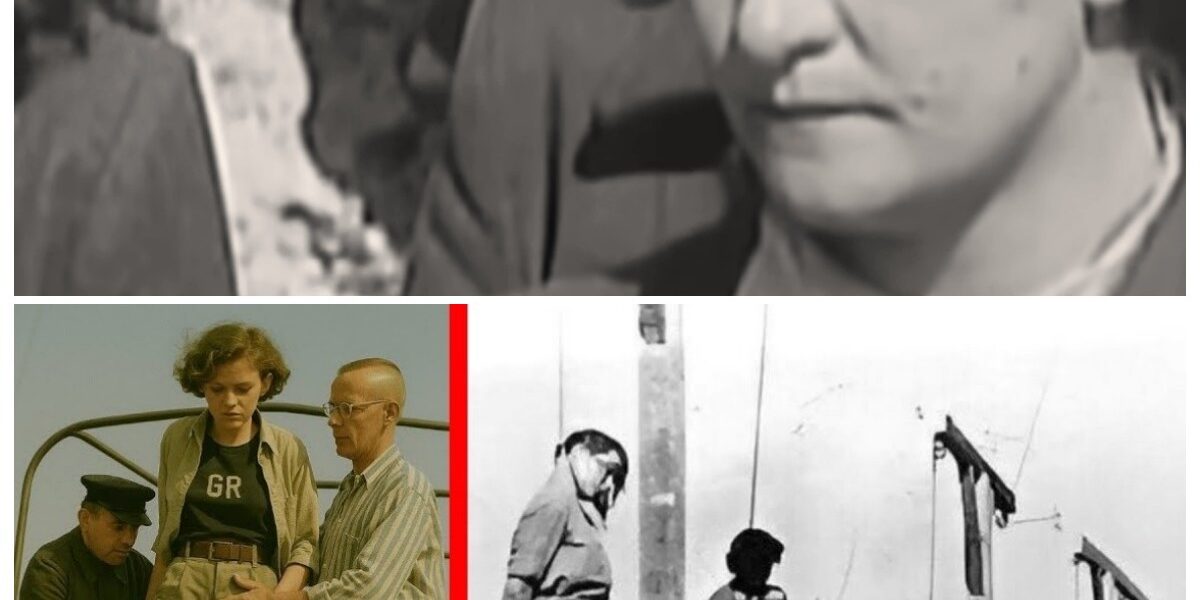
On the morning of July 4, 1946, Biskupia Górka, an
old hill overlooking Gdańsk, became the site of a historic reckoning.
A large wooden scaffold
had been erected, fitted with eight nooses, each one waiting for a condemned war criminal.
Over 200,000 people gathered in silence, not out of hatred or bloodlust, but to witness
the end of something monstrous.
This was not a spectacle.
It was the final chapter of a
nightmare that had gripped Europe for years.
One by one, the prisoners were brought to the
gallows under heavy guard.
Jenny-Wanda Barkmann wore a black dress and stared ahead blankly.
Ewa Paradies said nothing as she walked to her death.
Elisabeth Becker was visibly shaking.
Gerda Steinhoff showed no emotion at all.
Wanda Klaff, once smug and assertive during
her time at the camp, now looked small and defeated.
Each woman climbed the steps
in silence, knowing what was coming.
There were no final speeches.
No last-minute
pleas.
Just a quiet procession to the rope.
The executions were carried out quickly, one
after the other.
The bodies were left hanging for an hour, not as a punishment,
but as an unmistakable statement.
The crowd watched without a sound.
No
applause, no shouting, no crying.
Just a heavy silence.
It wasn’t revenge.
It was
justice, measured, deliberate, and absolute.
The first Stutthof trial opened the door, but
justice did not stop there.
Between 1946 and 1947, the Polish government organized three more
major trials focused on crimes committed at the Stutthof concentration camp.
In the
second trial alone, 24 more former personnel, both men and women, were brought before
the court.
The evidence was overwhelming, the testimonies damning.
Five of the accused
were sentenced to death.
Others received long prison terms for their roles in
the daily brutality of the camp.
The process was methodical.
Every name uncovered
in survivor accounts, every face identified in photographs, was investigated.
No matter how
minor their role seemed, each individual who had served in the camp was scrutinized.
The
courts didn’t care how long someone had worked there.
Some of the women had been stationed at
Stutthof for only a few weeks or months.
That didn’t matter.
Their presence meant they had
witnessed the starvation, the forced labor, the shootings, the gassings.
And they had
stood by in silence, or worse, participated.
These trials were not fast, and they were not
easy.
Witnesses had to relive horrors.
Prosecutors had to sort through records and testimonies
stained with grief and violence.
But the process moved forward with one purpose: to make sure
that what happened at Stutthof was not forgotten, and that those who allowed it to happen would
face the consequences, no matter how long it took.
When Stutthof was liberated by Soviet
troops, the war was already over for most of Europe.
But inside the camp,
the silence spoke of something far more chilling.
Only about 100 prisoners
were still alive, barely.
Starved, sick, and broken, they were the final witnesses to a
nightmare that had consumed over 65,000 lives.
The rest had either perished in the camp or been
forced onto death marches in the final months, where exhaustion, cold, and bullets
finished what starvation had started.
The camp was still.
No more barking
orders, no more screams, no more gunshots.
But the silence wasn’t comforting.
It was
heavy, haunted by what had happened there day after day for nearly six years.
The Soviets
walked through the grounds not as conquerors, but as stunned observers to a place where
civilization had collapsed into barbarity.
Stutthof wasn’t just liberated, it was exposed.
The crimes committed there couldn’t be undone.
The gates were open, but the memory of
what had happened inside would never leave.