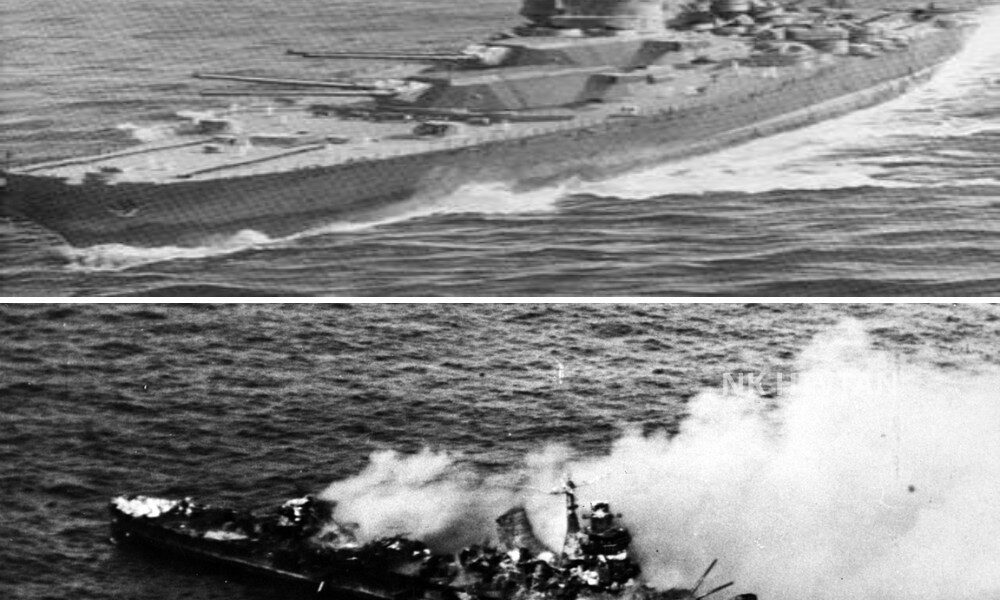

The Biggest Guns Ever Built… That Barely Did Anything. How Japan’s 18-Inch Naval Cannons Became a Colossal Miscalculation

They were the largest guns ever mounted on a warship.
Each barrel was wider than a small room.
Each shell weighed more than a pickup truck and could gouge the earth like a meteor.
And after four years of war, those legendary 18-inch guns sank exactly one enemy ship.
Not a fleet. Not a capital ship. One destroyer.
How did the most powerful naval artillery system in history end up being one of the least effective weapons of the Second World War? The answer isn’t a mystery of courage or crew quality. It’s a story of physics, economics, and brutal math—a case study in how chasing “the biggest” can quietly undermine everything else.
Let’s break down how awe-inspiring firepower turned into strategic dead weight.
The Dream: Absolute Naval Supremacy
When Japan laid down the keel for its ultimate battleship, the goal was simple: build something no enemy could match. Bigger guns meant longer range. Heavier shells meant more destructive power. If a single hit could end a fight, then size would win wars.
The main batteries measured 18.1 inches in diameter—still the largest naval guns ever put to sea. Each shell weighed roughly 3,200 pounds. They were taller than an average adult and wide enough to fill a doorway. On paper, the numbers were staggering:
- Maximum range: roughly 26 miles
- Explosive force: enough to create a crater tens of feet deep
- Psychological impact: unmatched
In theory, no enemy vessel could survive a direct hit.
In practice, the guns almost never hit anything.
The Cost Nobody Likes to Add Up
Let’s start with the economics, because this is where the story already turns grim.
The ship cost around 137 million yen in 1940, a staggering sum for a country with limited industrial depth. That amount could have produced roughly 1,000 modern fighter aircraft at the time. Japan built two of these massive battleships.
That’s 2,000 fighters that were never built.
In a war that would ultimately be decided by air power, radar, and carrier aviation, Japan invested a massive share of its resources into two floating artillery platforms that rarely fired their main guns in anger.
Opportunity cost is invisible—but it can be fatal.
The Combat Record: One Shot, One Ship
Here’s the most uncomfortable statistic of all:
In the entire war, the main guns fired at enemy surface ships exactly once.
That moment came during the Battle off Samar, part of the larger Leyte Gulf engagement. Hundreds of shells were launched toward enemy escort carriers and destroyers.
Hits scored by the main guns: zero.
The only ship definitively sunk in surface combat was a destroyer—and that damage came from secondary batteries, not the famous 18-inch guns.
So what happened?
Problem #1: The Guns Were Too Powerful
This sounds ridiculous until you see the effects.
When the battleship fired a full broadside, the overpressure from the blast was so intense that it damaged the ship itself.
Reports from crew and postwar analysis revealed that firing the main guns could:
- Knock out radio communications
- Damage range-finding equipment
- Destroy spotting aircraft stored on deck
- Cause lasting hearing damage to crew members—even through steel bulkheads
In other words, the ship literally injured itself when using its primary weapon.
Naval guns are supposed to be force multipliers. These guns were force disruptors.
Problem #2: The Earth Gets in the Way
The advertised maximum range—26 miles—sounds incredible until you remember one inconvenient detail:
The Earth is curved.
At distances beyond roughly 30,000 yards, targets begin to drop below the horizon. You can’t directly see what you’re shooting at.
Yes, theoretical firing solutions existed. Yes, spotter aircraft could help. But in real combat conditions—smoke, weather, evasive maneuvers—this became nearly impossible.
Japanese optics were excellent for their time, but even under ideal conditions they could reliably track targets only to about 27,000 yards.
In actual combat, effective engagement range dropped closer to 18,000 yards.
That means half the gun’s theoretical range was unusable.
You can’t hit what you can’t see.
Problem #3: Accuracy Was Brutally Low
Here’s where the math turns unforgiving.
At around 20,000 yards, the probability of a single shell scoring a hit was estimated at 0.2%.
That’s not a typo.
Not 2%.
Zero-point-two percent.
Statistically, the ship needed to fire about 500 shells to expect one hit at long range.
Each barrel could fire roughly two rounds per minute. A full broadside took around 30 seconds to reload. Even in perfect conditions, achieving a single hit required tens of minutes of uninterrupted firing.
And naval combat rarely offers uninterrupted anything.
Problem #4: The Enemy Didn’t Play Along
The battleship was designed to fight other battleships—slow, massive targets moving predictably at long range.
That’s not what the Pacific War delivered.
Instead, the dominant threats were:
- Aircraft
- Fast destroyers
- Carrier task forces
- Submarines
Small, agile ships could zigzag, lay smoke, and close distance rapidly. Aircraft could strike from beyond gun range. Submarines didn’t need to engage in artillery duels at all.
One American destroyer commander who faced the battleship later described the experience not as terror, but as opportunity. The massive shells splashed spectacularly—but the gaps between impacts were wide enough to maneuver through.
The guns were terrifying to watch. They were just not very effective.
Problem #5: Firepower Without Information Is Blind
Big guns require precise targeting data. That means radar integration, air spotting, communications, and coordination.
Japan lagged behind in radar technology throughout much of the war. When combined with the self-inflicted damage caused by firing the guns, this meant the ship often lost situational awareness at the very moment it needed it most.
In contrast, American forces increasingly relied on radar-directed fire control, aircraft spotting, and networked fleets.
Accuracy beat size. Information beat brute force.
The Strategic Irony
The ultimate irony is this: the battleship was built to win a decisive surface engagement that never came.
By the time it was operational, naval warfare had already changed.
Aircraft carriers projected power farther, faster, and more flexibly than any gun platform. Fighters and bombers could strike from hundreds of miles away, ignoring armor thickness entirely.
The ship was not obsolete because it was poorly built. It was obsolete because it was perfectly optimized for a war that no longer existed.
What the Guns Really Did Well
To be fair, the guns weren’t useless in every sense.
They:
- Created massive shock and awe
- Forced enemy ships to maneuver defensively
- Consumed enemy attention and resources
But those effects were psychological, not strategic.
Wars are not won by intimidation alone.
The Lesson Hidden in Steel
The story of these 18-inch guns isn’t about failure of engineering. It’s about the danger of designing for extremes.
Bigger doesn’t always mean better. Power without precision becomes spectacle. And investing everything into a single, overwhelming capability can leave fatal gaps elsewhere.
Japan didn’t lose because its sailors lacked skill or courage. It lost because it placed too much faith in a symbol—an icon of dominance—while the nature of war quietly evolved.
The biggest guns in history were magnificent.
They were terrifying.
They were awe-inspiring.
And in the end, they were almost irrelevant.
That’s the brutal truth behind how the most powerful naval artillery ever built became one of the least effective weapons of the war—and why size alone has never been enough to win it