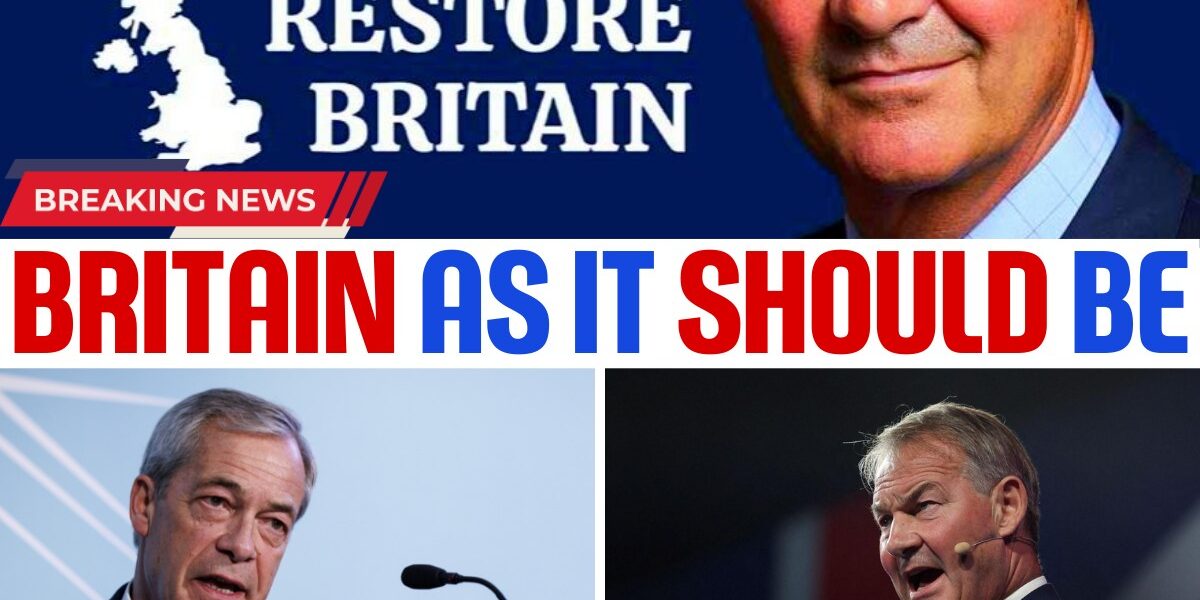
Restore Britain Registers as Official Political Party, Signalling Further Fragmentation on the British Right. phunhoang

Rupert Lowe, the former Reform UK deputy chairman and Member of the European Parliament, has completed the formal registration of Restore Britain with the Electoral Commission, transforming the organisation from a pressure group into a fully constituted political party eligible to contest elections across the United Kingdom. The move, confirmed following Lowe’s public announcement in mid-February 2026, introduces a new actor into an already crowded field on the right of British politics and intensifies debate over the long-term cohesion and electoral prospects of conservative and populist forces.

The party’s platform, detailed in a comprehensive policy document released alongside the launch, centres on a series of hardline positions. These include the implementation of mass deportations supported by detailed assessments of legal, logistical, and legitimacy questions; a commitment to achieving net-negative immigration through stricter controls and removal mechanisms; a public referendum on the reintroduction of capital punishment; and the abolition of the Scottish Parliament and the Senedd in Wales as part of a broader restoration of a unitary constitutional framework. Additional measures focus on protecting traditional British institutions, such as safeguarding the status of the public house, alongside wider calls for enhanced national sovereignty and reduced supranational commitments.
The launch gained significant visibility through a seven-minute video filmed on Lowe’s Norfolk farm, which amassed tens of millions of views across digital platforms. An early endorsement from Elon Musk, who urged followers to support Lowe as the figure most likely to deliver decisive change, contributed to the rapid dissemination of the message. The party set membership at an accessible annual fee of £20 with a streamlined digital sign-up process, factors that facilitated swift organisational growth according to self-reported figures.
Restore Britain has claimed an unprecedented membership trajectory: reaching 50,000 members within three days of the announcement, 70,000 by day five, 80,000 by day seven, and 100,000 by the end of the second week. These numbers, while impressive in historical comparison, remain self-reported and have not yet undergone independent verification by electoral or third-party auditors. For perspective, Reform UK required approximately five months to grow to the same membership threshold after Nigel Farage assumed leadership in mid-2024. Earlier movements such as UKIP peaked at around 45,000 members over more than a decade, while the Social Democratic Party’s rapid 1980s expansion reached roughly 65,000 in its first full year.

Early polling data provide further insight into the party’s potential reach. Independent surveys conducted by Find Out Now in late February and early March 2026 placed Restore Britain at 7 per cent national vote intention, a notable figure for an entity only weeks old. Support appeared strongest among younger voters aged 18 to 29, registering at 11 per cent in one tracker, and 15 per cent of 2024 Reform UK voters indicated a shift toward the new party. The 7 per cent level positioned Restore Britain as the sixth-largest party in those polls, trailing Reform UK (25 per cent), the Greens (18 per cent), Labour and the Conservatives (both near 16 per cent), and the Liberal Democrats (11 per cent).
Despite these indicators of momentum, substantial structural challenges confront the new party. Name recognition for Rupert Lowe remains limited: surveys in February 2026 found that 86 per cent of the general public could not identify him from a photograph, with similar figures among Reform voters ranging from 71 to 86 per cent. In contrast, Nigel Farage retains near-universal recognition within relevant voter cohorts. Low public profile presents a particular hurdle under the United Kingdom’s first-past-the-post electoral system, which favours parties with geographically concentrated support and punishes those with diffuse national backing.
Historical evidence underscores the difficulty. In the 2024 general election, Reform UK secured 14.3 per cent of the vote — more than 4.1 million ballots — yet returned only five Members of Parliament, requiring roughly 800,000 votes per seat won. By comparison, the Liberal Democrats, with a slightly smaller national vote share but more targeted distribution, secured 72 seats. UKIP’s peak performance of 12.6 per cent in 2015 yielded a single seat, while even higher shares have historically failed to deliver proportional representation for new or challenger parties lacking regional strongholds.
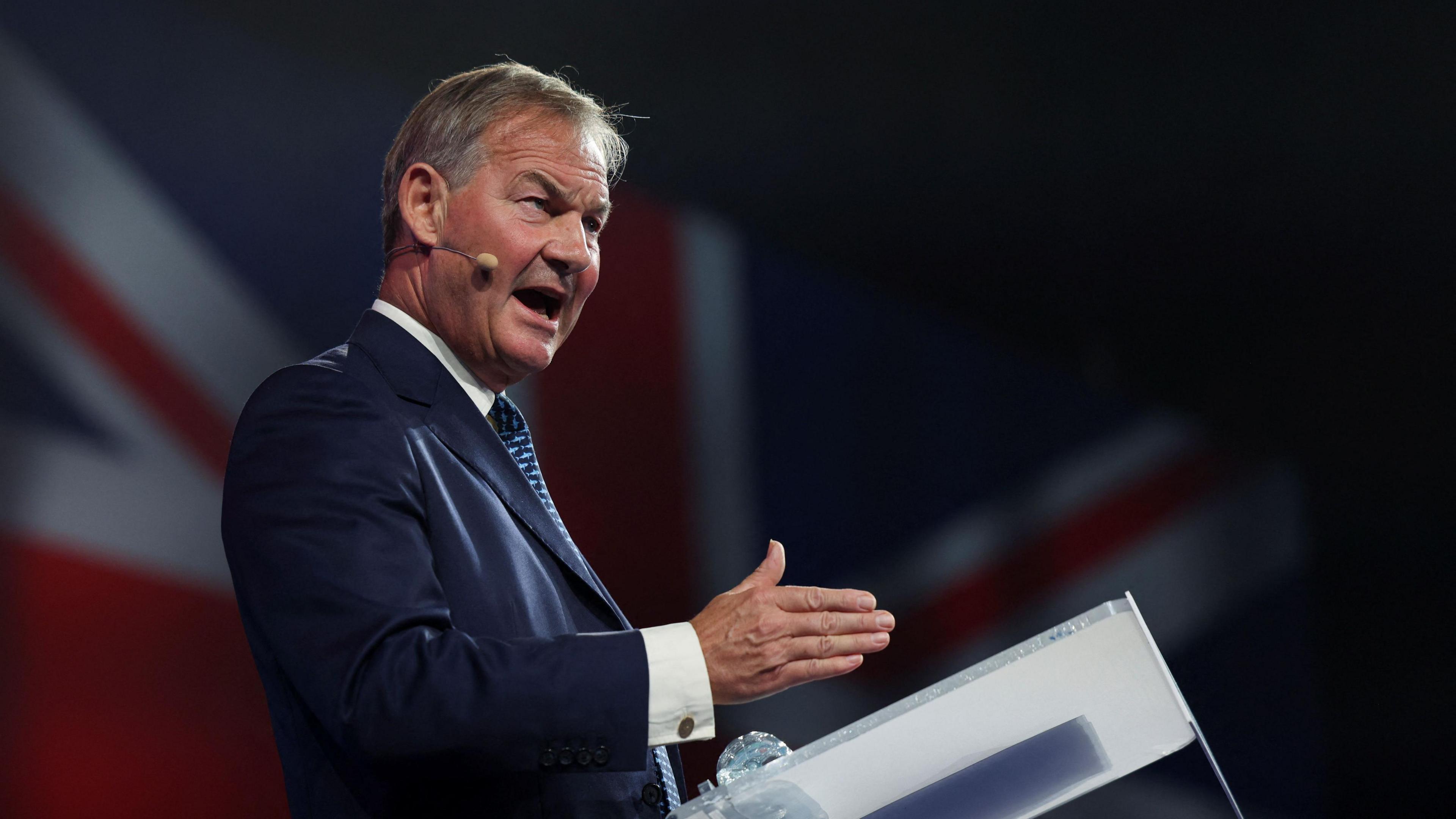
Analysts project that, at current polling levels and assuming evenly spread support, Restore Britain would be likely to secure zero to very few parliamentary seats under existing boundaries. Optimistic scenarios concentrate on one to five constituencies where local organisation is strongest, such as Great Yarmouth, while more realistic assessments anticipate the party functioning primarily as a vote-splitter in marginal seats. Such fragmentation could inadvertently benefit Labour, Liberal Democrat, or Green candidates in contests where the right-of-centre vote divides between Reform UK, the Conservatives, and Restore Britain.
The party’s emergence has already coincided with observable shifts in the positioning of other political actors. Labour’s immigration rhetoric and policy proposals in 2025, including extended settlement qualification periods, higher skill thresholds for visas, and enhanced deportation powers, adopted elements of language and substance previously associated with Reform UK and Brexit-era campaigns. Academic evaluations of these adjustments suggest they resulted in modest losses among Labour’s core voters without corresponding gains among those prioritising stricter immigration controls.
Reform UK itself has adjusted its messaging in response to the new competition. While maintaining firm positions on immigration enforcement, the party has moderated certain economic pledges and adopted a more mainstream tone on international relations. Farage has publicly distanced Reform from Restore Britain’s more expansive deportation proposals, describing them as exceeding boundaries of reasonableness, decency, and morality, and has warned of the risks posed by what he termed extreme ethno-nationalist tendencies.
The right-of-centre space now accommodates multiple competing entities, including Reform UK, the Conservatives, Restore Britain, Advance UK, UKIP remnants, the Heritage Party, and smaller groups. Advance UK, which claimed 40,000 members and attracted high-profile endorsements before seeing its leader publicly rebuffed by Lowe, secured only 154 votes in a February 2026 by-election — five fewer than a novelty candidate from the Official Monster Raving Loony Party who did not actively campaign.

Restore Britain’s organisational efforts continue to focus on local branch development, volunteer recruitment, and candidate selection for upcoming council elections. The party has reported defections from existing councils, including several in Kent that elevated it to the third-largest group on that authority. These grassroots steps aim to build the infrastructure required for sustained campaigning, though translating digital visibility and membership numbers into electoral success will require overcoming the recognition gap and the first-past-the-post barrier.
The broader significance of Restore Britain may lie less in immediate parliamentary gains than in its capacity to influence the wider political agenda. Historical precedents demonstrate that challenger movements can reshape debate and compel established parties to respond even when they secure limited direct representation. UKIP, despite never forming a government or winning substantial seats, exerted decisive pressure that contributed to the 2016 European Union referendum. Whether Restore Britain can achieve comparable agenda-setting influence on immigration, sovereignty, and constitutional questions will depend on its ability to maintain momentum, clarify its public profile, and navigate the fragmented landscape it has entered.
For the United Kingdom’s political system, the registration of Restore Britain adds another layer of complexity to an already diverse right-of-centre spectrum. As the country approaches future electoral cycles, the interaction between these competing voices — and the extent to which vote splitting alters outcomes — will remain a key variable in determining the balance of power at Westminster.
.webp)
.webp)
.webp)
.webp)
.webp)