
On January 18, 1945, the cold did not arrive by chance.
It was already there, waiting, sharp and merciless across the plains of occupied Poland.
Snow covered the ground in a thin white layer that reflected no warmth, only the pale sky of a winter that refused to soften.

Inside Auschwitz concentration camp, thousands of prisoners sensed that something was shifting.
Rumors had been spreading for days.
The sound of distant artillery carried faintly through the air.
The Red Army was advancing.
The guards knew it too.
That morning, orders were given.
The camp would be evacuated.
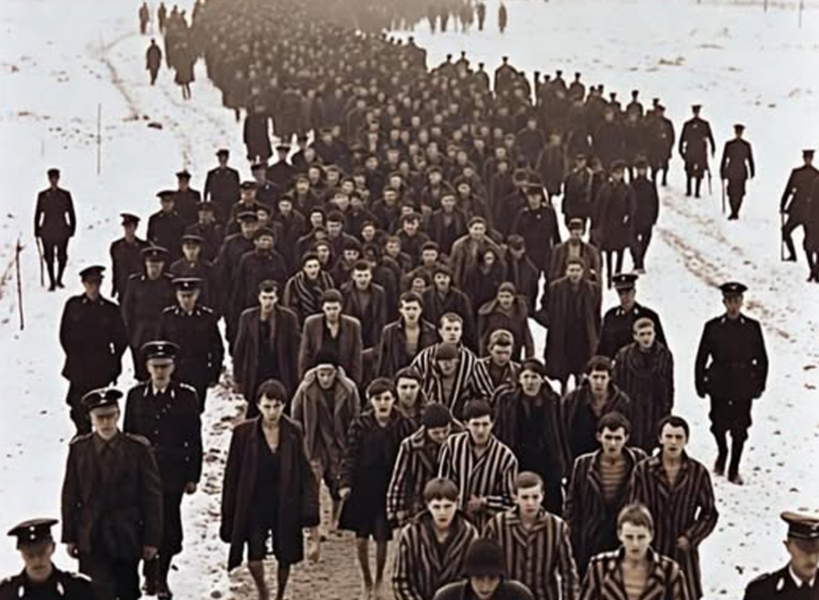
Prisoners were to march westward, deeper into German territory.
There were no preparations for survival.
No winter coats were distributed.
No additional rations were handed out.
Many wore thin striped uniforms and wooden clogs.
Some wrapped scraps of fabric around their feet in a desperate attempt to fight the frost.
The gates opened not to freedom, but to another form of suffering.
Among those forced into the column was a sixteen-year-old boy named Aron Lewin.
Months earlier, he had been separated from his parents upon arrival at Auschwitz.
He had learned quickly that survival depended on silence, obedience, and the ability to endure hunger without complaint.
Now he faced something different.
A march into the unknown.
The line of prisoners stretched for miles as they were driven into the snow under armed SS guard.
Anyone who slowed was shouted at.
Anyone who stumbled was struck.
The first shots were heard before they had even cleared the perimeter of the camp.
A man too weak to continue collapsed near the ditch.
The column did not stop.
It could not.
Aron fixed his eyes on the back of the prisoner ahead of him and began counting steps.
One.
Two.
Three.
He repeated the rhythm inside his head as a way to remain conscious.
The wind sliced through his clothing, stealing warmth from his bones.
Within hours, he could no longer feel his toes.
By nightfall, several bodies lay scattered along the roadside.
The snow slowly covered them, erasing shape and identity.
Guards urged the column forward relentlessly.
There would be no shelter.
No fire.
No rest beyond brief pauses that lasted only minutes.
The march continued through villages where curtains shifted behind dark windows.
Civilians watched from a distance as lines of skeletal figures passed by like ghosts.
No one intervened.
On the second day, hunger became unbearable.
Aron had not eaten properly in weeks.
Now there was nothing at all.
His stomach clenched violently, then seemed to surrender.
Thirst burned his throat, but snow could not be gathered without risking punishment.
Beside him walked an older man named Jakob, once a schoolteacher.
Jakob whispered multiplication tables under his breath as they marched.
Numbers anchored him to something rational in a world that had abandoned reason.
Aron listened and repeated them silently.
It gave him focus.
Late that afternoon, Jakob’s steps faltered.
His breathing turned ragged.
Aron felt the shift before he saw it.
The older man swayed and dropped to his knees.
For a brief second, time froze.
Aron reached toward him instinctively, but a gunshot shattered the stillness.
Jakob fell forward into the snow.
The line continued moving.
Aron forced himself to step around the body.
He did not look back again.
By the third day, the march had become mechanical.
Frostbite blackened fingers.
Faces turned gray with exhaustion.
Some prisoners walked with eyes closed, guided only by the shove of the person behind them.
Falling meant death.
Everyone understood that rule without needing to speak it.
At one point, the column halted near a forest clearing.
Guards argued among themselves, their voices tense.
Distant artillery echoed faintly.
The war was clearly nearing its end.
Yet the cruelty showed no sign of weakening.
If anything, it intensified.
Aron’s legs trembled violently.
He felt himself drifting toward the edge of consciousness.
The snow beneath him seemed inviting, almost soft.
Just a moment to rest.
Just a moment to close his eyes.
He knew what would happen if he did.
As the column resumed movement, something unexpected occurred.
A prisoner ahead slipped, and instead of stepping away, two others caught him under the arms and dragged him upright.
The guards shouted, but no shot followed.
The three men continued walking together, supporting one another in defiance of exhaustion.
Aron watched this small act and felt something shift inside him.
Not strength.
Not hope in the grand sense.
But a refusal to surrender alone.
Hours later, when his own legs began to give out, another prisoner steadied him without speaking.
No heroics.
No declarations.
Just an arm beneath his shoulder.
The march lasted days.
Those who survived were crammed into open freight cars and transported to other camps, where suffering continued.
Many did not endure the journey.
But Aron did.
Months later, he would stand in a displaced persons camp, thinner than ever, yet alive.
The war ended.
The regime that had orchestrated the death marches collapsed.
Evidence emerged.
Testimonies were recorded.
The world learned what had been attempted in those final desperate months.
Aron eventually rebuilt a life.
He emigrated, studied, and later spoke publicly about the march.
He never described it as an act of chaos.
He described it as deliberate cruelty aimed at erasing witnesses.
But he also spoke of the men who lifted one another when falling meant execution.
He often said that the road west was where he understood something profound.
A system built on dehumanization demanded that prisoners see themselves as alone.
Yet survival sometimes depended on the smallest shared act of humanity.
January 18, 1945 was not merely a date of evacuation.
It was the beginning of one of the most brutal chapters of the Holocaust’s final months.
The Death Marches proved that even as defeat loomed, cruelty could persist with terrifying discipline.
The war was ending.
The suffering was not.
Remembering that frozen road is not about dwelling in darkness.
It is about understanding how far a system can descend when human beings are reduced to numbers, and how even then, dignity can flicker in the act of one person holding another upright.
Aron’s first steps after liberation felt different from the march.
They were unforced.
Unthreatened.
Each movement belonged to him.
And with each step, he carried the memory of those who had fallen behind in the snow.