
The cold arrived before the sun.
In January 1944 the winter in Alsace felt endless, a gray and merciless season that seemed determined to freeze the last traces of life from the land.
Inside the Schirmeck security camp the cold was worse than anywhere else.

Wind pushed through the wooden barracks and slipped beneath the thin uniforms of the prisoners.
Frost gathered along the edges of bunk beds and crept across the walls like pale veins.
Before dawn the guards blew their whistles.
Roll call.
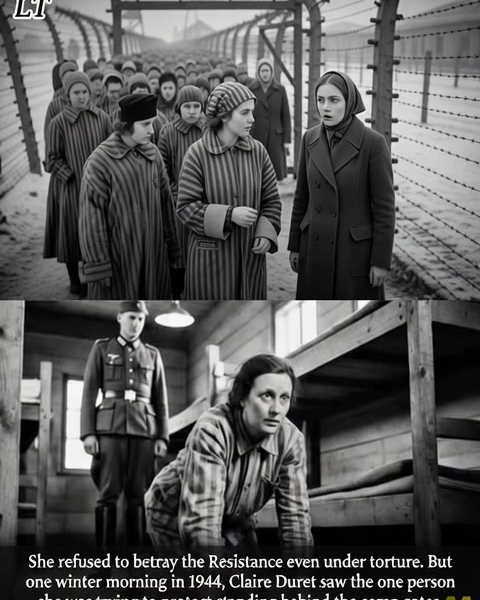
Women stumbled from their bunks, pulling on stiff striped coats and wooden clogs that offered little protection from the frozen ground.
They walked outside and formed long silent lines in the snow.
No one spoke.
Speech was dangerous in Schirmeck.
The guards believed silence meant obedience.
Among the prisoners stood Claire Duret.
She was twenty nine years old.
Once she had been known as a teacher’s daughter from Strasbourg, a quiet young woman with dark hair and thoughtful eyes who spent her evenings reading in small cafés along the river.
Now she was simply prisoner number 382.
Her body shook slightly as she stood in line that morning.
The trembling was not only from the cold.
Pain moved through her ribs each time she inhaled.
The bruises from her last interrogation had not yet faded.
She forced herself to stand straight anyway.
Weakness invited attention.
Attention invited punishment.
Around her the women stared forward with hollow expressions.
Many had been here for months.
Some had been here for years.
Every face carried the same quiet understanding.
Schirmeck was not a death camp.
There were no gas chambers.
But cruelty lived there just the same.
Punishment was systematic.
Carefully organized.
Designed to break the human spirit without leaving obvious traces.
The interrogations were the worst.
Claire had learned that during her first week.
She had been arrested in October at a small convent outside Strasbourg.
The convent had served as a secret meeting place for members of the Resistance.
Claire’s role had been simple but dangerous.
She carried messages.
Sometimes coded routes used by Allied pilots escaping through France.
Sometimes the names of safe houses.
Sometimes small maps hidden in the lining of her coat.
She had believed the system was safe.
Until the night the Gestapo arrived.
The raid came after midnight.
Heavy fists pounded on the convent door.
Men shouted orders.
Lights flooded the courtyard.
Claire had tried to burn the documents she carried but a guard grabbed her before the fire could spread.
Within hours she was transported to Schirmeck.
The interrogations began immediately.
The questions were always the same.
Who leads the Resistance cell in Strasbourg
Who organizes the escape routes
Where are the safe houses
Claire knew the answers.
The leader of the network was her younger brother.
Étienne Duret.
He was only twenty four years old but already deeply involved in the underground resistance.
Étienne had begged her not to help the network.
He knew the risks.
But Claire had insisted.
She believed protecting their country was worth any danger.
Now she understood how dangerous those choices truly were.
Every interrogation ended the same way.
Claire refused to speak.
The guards struck her.
Threatened her.
Left her alone in cold cells for hours.
Still she remained silent.
Because saying one name would destroy everything.
That morning at roll call Claire stood with her eyes fixed on the ground.
Snow drifted gently through the gray sky.
The camp gate creaked open behind the lines of prisoners.
New arrivals.
The women rarely looked at them.
Seeing fresh prisoners meant remembering how frightened they themselves had once been.
But something made Claire glance up.
Perhaps it was the sound of shouting.
Perhaps instinct.
Perhaps fate.
Her eyes moved toward the gate.
And suddenly the world seemed to stop.
A group of guards stood there with a young man between them.
His hands were bound.
His face was bruised.
But she knew him instantly.
Étienne.
For a moment Claire could not breathe.
The snow beneath her feet seemed to tilt.
Her younger brother stood only twenty meters away surrounded by armed soldiers.
He looked thinner than she remembered.
Older somehow.
But it was unmistakably him.
Their eyes met.
Shock passed across his face.
Then something else.
Understanding.
A German officer stepped forward holding a folder.
Even from the distance Claire recognized the paper.
Her file.
The officer glanced from the folder to Étienne.
Then to Claire.
A slow smile formed on his face.
In that moment Claire understood everything.
Her silence had not protected her brother.
It had simply changed the method of interrogation.
The guards marched Étienne across the yard.
Prisoners were ordered to keep their eyes forward.
But Claire could feel him moving closer.
She wanted to scream.
Wanted to run toward him.
Instead she stood perfectly still.
Because she understood the rules of the game now.
Fear was their weapon.
Breaking families was their strategy.
The officer stopped in front of her.
Your brother has arrived he said calmly.
Claire said nothing.
He continued speaking as if discussing ordinary business.
Perhaps seeing him will help your memory.
Still she remained silent.
The officer watched her carefully.
Then he gestured toward Étienne.
Take him away.
As the guards pulled her brother toward the interrogation building, Étienne looked back once.
His expression was not fear.
It was determination.
He shook his head slightly.
A silent message.
Do not speak.
Claire lowered her eyes.
Snow continued falling quietly around the prisoners.
But inside her chest a storm had begun.
Because she knew the interrogations would begin again.
And this time she would not be the only one paying the price.
What happened next inside Schirmeck would remain hidden in silence for many years.