
From 1940 until the final spring of the war, the granite quarry beneath Mauthausen Concentration Camp carved more than stone.
It carved men.
It carved breath into dust.
It carved hope into silence.
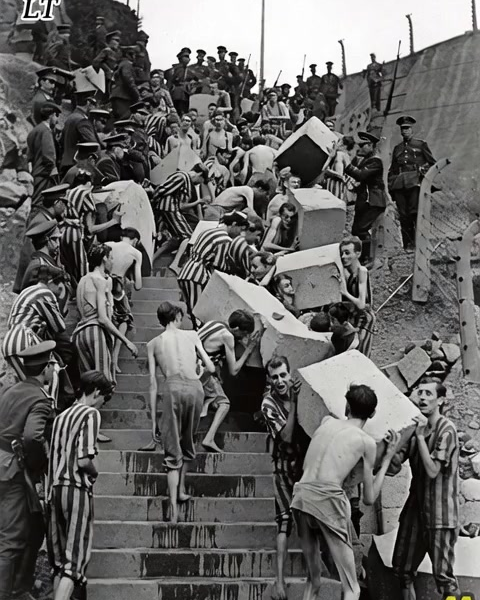
The staircase that rose from the Wiener Graben quarry to the main camp had 186 uneven steps.
Granite, sharp-edged, steep, merciless.
Officially it was only a passageway.
To the prisoners, it became something else entirely.
A ritual of exhaustion.
A theater of cruelty.
A place where death did not hide in shadows but waited openly in daylight.
They came from every direction of occupied Europe.
Jewish families torn from their homes.
Political prisoners who had dared to resist.
Soviet prisoners of war.
Roma men.
Students.
Priests.
Fathers.
Sons.
Each one reduced to a number stitched onto striped fabric that did nothing to shield them from the cold Austrian wind slicing through the quarry.
Before dawn, whistles shrieked across the camp.
The men were driven downward into the quarry, skeletal figures descending toward the pit that would test the limits of their bodies.
The granite blocks waited at the bottom, jagged and heavy, some weighing nearly fifty kilograms.
Each prisoner was ordered to hoist one onto his shoulders.
Then came the climb.
One step.
Then another.
The staircase rose at a punishing angle, uneven under bare or broken shoes.
In winter, ice slicked the stone.
In rain, mud and blood blended into a slippery film.
Guards lined the path above and below, rifles slung casually, boots planted firmly, eyes scanning for weakness.
They shouted.
They struck.
They shoved.
A single stumble could begin a collapse.
If one man fell, the weight of his stone pulled him backward into the prisoner behind him.
Granite met bone.
Bodies crashed together.
The staircase transformed into a cascade of limbs and shattered ribs.
Those who survived the fall were often beaten for delaying the climb.
Some were shot where they lay.
The guards sometimes watched with amusement.
Suffering became performance.
Exhaustion became entertainment.
By 1942, Mauthausen had been classified as a Grade III camp, a place reserved for prisoners considered beyond redemption.
Labor there was not meant to reform.
It was meant to erase.
The term extermination through work would later appear in historical accounts, but for the men climbing those steps, the meaning required no translation.
Their hearts pounded thinly inside hollow chests.
Their hands split open against rough stone.
Their breaths came short, ragged, shallow.
Each day, they climbed the 186 steps multiple times.
Each day, more did not return.
Jakob Weiss was twenty-eight when he arrived in Mauthausen.
Before the war, he had studied architecture in Vienna.
He once believed buildings could uplift humanity, that structures could inspire awe and shelter dreams.
Now he found himself forced to carry granite up a staircase designed not to elevate but to destroy.
He was not strong when he arrived, and he grew weaker with every passing week.
Starvation carved shadows beneath his eyes.
His uniform hung from him like fabric draped over bone.
Yet something in him refused to surrender.
Perhaps it was memory.
Perhaps it was stubbornness.
Perhaps it was the quiet face of his younger sister, whom he had not seen since their arrest.
On his third month in the quarry, Jakob stumbled halfway up the stairs.
His foot slipped on wet stone.
The granite block shifted on his shoulder.
For one terrible second, he felt himself falling backward into the line of men behind him.
But another prisoner caught him.
A hand, thin and trembling, pressed against his back and steadied him.
The man behind him whispered only one word.
Steady.
They climbed together that day.
Jakob never learned the man’s name.
Names were dangerous.
Names invited grief.
But from that moment, whenever the whistle blew, Jakob searched for that same hollow-eyed figure in the line.
They carried stone side by side when they could.
When one weakened, the other adjusted his pace just enough to prevent disaster.
They never spoke more than necessary.
Words required energy they did not possess.
Winter came hard in 1944.
Frost sealed the stairs in ice.
The wind cut through the quarry like a blade.
Men died mid-climb, collapsing from heart failure or exposure.
Guards grew more impatient as the war shifted beyond the camp’s walls.
Rumors filtered through the prisoners like faint radio static.
Allied forces were advancing.
The Reich was shrinking.
Hope, fragile and terrifying, began to flicker.
One morning in early 1945, the line was thinner than ever.
Jakob felt the granite bite into his shoulder as he began another ascent.
Halfway up, a prisoner near the top slipped.
He fell forward, knocking two others down.
The crash thundered through the staircase.
Bodies tumbled.
Stone shattered against skull.
Jakob froze.
Above him, chaos erupted.
Guards shouted.
Shots cracked through the air.
Men scrambled to regain footing.
In the confusion, he saw his silent companion lose balance.
The man’s block shifted violently, dragging him sideways toward the edge of the staircase where the drop plunged sharply into the quarry.
Jakob moved without thinking.
He dropped his own stone.
The impact echoed.
A guard screamed behind him.
But Jakob lunged upward, grasping the man’s sleeve just as his foot slipped into open air.
For a heartbeat, they hovered between gravity and will.
Jakob’s weakened arms trembled under the combined weight.
The man’s eyes met his, wide not with fear but with disbelief.
More shots rang out.
A guard struck Jakob across the back with a rifle butt.
Pain exploded through him.
Still he held on.
Another prisoner stepped forward, then another.
Hands gripped fabric, wrists, bone.
For a moment that defied the machinery of cruelty surrounding them, the men formed a chain.
A human chain on the Stairs of Death.
They pulled the fallen man back onto the stone.
The guards beat them for the disruption.
Jakob tasted blood.
But something had shifted.
For an instant, the staircase had not belonged to terror.
It had belonged to them.
Weeks later, on May 5, 1945, American soldiers entered Mauthausen.
The gates opened.
The guards fled or surrendered.
The men who remained alive emerged from barracks like shadows stepping into sunlight.
More than ninety thousand had already perished across Mauthausen and its subcamps.
The quarry stood silent.
The 186 steps remained.
Jakob survived.
Years later, he returned to the site not as a prisoner but as a witness.
The staircase had become a memorial.
Visitors stood at the top and looked down, trying to measure its height with their eyes.
Some descended slowly, carefully, as if the stone might still remember.
Jakob stood halfway down.
He placed his hand against the granite and closed his eyes.
He did not remember only the beatings or the screams.
He remembered the moment suspended between falling and being saved.
He remembered hands reaching in defiance of fear.
He remembered that even in a place engineered for annihilation, humanity had refused complete surrender.
Architecture had been twisted into a weapon there.
Stone had been used to grind flesh into dust.
Yet the same steps that carried thousands toward death had once held a fragile chain of men choosing to lift one another.
Step by step.
The Stairs of Death remain today, not merely as relics of cruelty, but as testimony.
They stand as proof that systems can be designed to destroy, that hatred can be structured into stone, but also that a single act of courage can interrupt even the most calculated machinery of despair.
Jakob often said later that he had not saved a man that day.
They had saved each other.
And in doing so, they had reclaimed the staircase for one brief, eternal moment.