The Irish Have Just Made HISTORY — Sending a Powerful Message to Britain on How to PUSH BACK Against Starmer!!!

The Emerald Gridlock: How a Spark in Rural Ireland Lit a Nationwide Fire
DUBLIN — It begins with the low, rhythmic thrum of diesel engines, a sound that usually signals the start of a workday in the pastoral stretches of the Irish countryside. But lately, that sound has moved from the fields to the arteries of the state. Across the Republic of Ireland, the silence of the morning is increasingly broken by the sight of massive agricultural tractors and heavy-duty logistics trucks rolling at a deliberate, agonizing crawl. This is not a parade; it is a blockade. What started as a localized grievance over the soaring cost of fuel has metastasized into what organizers are calling the “Great Irish Rising,” a populist surge that is testing the limits of the state’s authority and the patience of its citizenry.

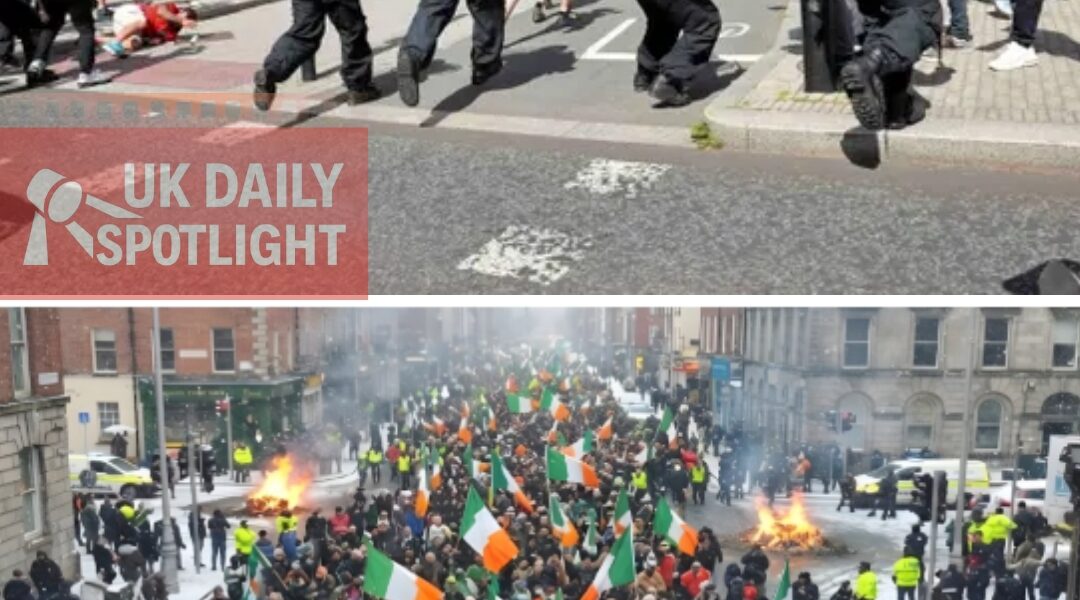
On O’Connell Street, the historic heart of Dublin’s revolutionary past, the avenue is currently packed shoulder-to-shoulder. It is a striking tableau of modern dissent: polished chrome trucks idling beneath the shadow of the Spire, surrounded by “proud Irish patriots” and bikers who have traveled from the furthest corners of the island to join the fray. The air is thick with the smell of exhaust and the palpable tension of a standoff. While the Gardaí (the national police) have issued stern warnings of arrests for any obstruction, the crowd has remained immovable, seemingly operating on the principle that if they cannot afford to run their country, they will simply grind the whole thing to a halt.
The response from the Irish government has been swift and, according to those on the ground, increasingly “heavy-handed.” Reports have surfaced—vetted through the chaotic but immediate lens of social media—showing the army being mobilized to assist in clearing key logistics hubs. At the White Gate Oil Refinery, a critical piece of national infrastructure, the scene turned violent as Gardaí moved in to dismantle barricades of scaffolding and steel. Footage circulated online shows farmers being forcibly removed from their tractor cabs, a visual that has only served to galvanize the movement. Each hard shove from a police officer and each threat of six months in jail seems to act as a recruitment tool, drawing more “reinforcements” into the convoys.
This is a battle of self-sufficiency versus globalist policy, or what some protesters have derisively termed “Net Stupid.” The grievance is simple: Ireland and its neighbors possess untapped resources and the potential for greater energy independence, yet the government remains tethered to environmental targets and international supply chains that the working class can no longer afford to sustain. For the Irish, a people with a long and storied history of community-led resistance, the current situation is less about a specific tax and more about the fundamental right to live and work in their own homeland without being priced out by their own government.
The power of the tractor in modern political dissent cannot be overstated. Unlike a marching protester, a ten-ton piece of farm machinery is a physical fact that cannot be easily moved by a police baton. When these vehicles descend on a city, they transcend the role of a protest tool; they become a siege engine. The “go-slow” tactics employed by these massive convoys mean that once they stop, the movement of the entire nation ceases. It is a logistical nightmare for the state, which finds itself trapped between the need to enforce the law and the risk of turning a fuel protest into a full-blown civil uprising.
The speed at which this movement has grown is a testament to the power of social media in the 21st century. Information that once would have been filtered through the evening news is now broadcast live from the cabs of trucks. Platforms are flooded with clips from accounts like The Liberal.ie and various “Patriot” channels, creating a real-time narrative of a nation on the brink. This digital connectivity ensures that even as the government tries to shut down one blockade, three more appear in different counties. The traditional media’s silence is often filled by the roar of the protesters’ own cameras, documenting every arrest and every confrontation.
There is a psychological threshold for any citizenry, a point at which the burden of living becomes heavier than the fear of the state. The English, long perceived as more stoic or perhaps more compliant, are watching the events in Ireland with a mix of curiosity and growing recognition. In the United Kingdom, diesel prices have also touched record highs, and the same anxieties about supply and demand are beginning to simmer. The Irish rising serves as a bellwether, a warning that when the cost of work exceeds the reward, the people will eventually turn around and say, “We’ve had enough of this.”
Government officials, for their part, argue that the blockades are illegal and dangerous, endangering the delivery of essential services and medical supplies. They frame the protesters as a vocal minority causing undue hardship to the broader public. However, the sheer size of the crowds on O’Connell Street suggests a broader base of support. When bus operators and truck drivers—the very people who keep the country moving—decide to stop, the “hardship” they cause is the point. They are demonstrating their essentiality by withdrawing it.
The history of Ireland is a history of the land and those who work it. From the Land League to the present day, the Irish have always been defined by a fierce attachment to their community and a refusal to back down under pressure. The current “fuel protests” are merely the latest chapter in that saga. While the tactical response from Dublin has been to use force to clear refineries and streets, there is little evidence that this is solving the underlying issue. A hard shove from a Garda does not lower the price of diesel at the pump; it only increases the resolve of the man being shoved.
As the protests enter their fifth day, the question remains: what is the endgame? The government appears unwilling to blink, fearing that a concession on fuel prices would embolden other sectors of the economy to strike or blockade. Conversely, the protesters have shown no sign of fatigue. The convoys are still growing, and the language being used by organizers has shifted from “protest” to “revolution.” The state’s reliance on “dirty government tactics” and “heavy-handed” policing may clear a road for an hour, but it cannot clear the sense of betrayal that has settled over the rural and working-class communities.
There is an unbelievable irony in the current situation. Ireland sits in an archipelago with vast energy potential, yet it finds itself paralyzed by energy costs. The inability of the political class to address self-sufficiency has created a vacuum of leadership that the “patriots” on the street are more than happy to fill. This is not just a disagreement over policy; it is a total failure of the social contract. When the people no longer believe their government is acting in their best interest, they stop asking for change and start demanding it through the sheer physical presence of their bodies and their machines.
The path forward is likely to be paved with a great deal of pain. Even if the current blockades are eventually broken by the army or the police, the spark has already been lit. The information has been shared, the tactics have been tested, and the citizenry has seen exactly how much power they hold when they act in unison. The English, the Irish, and the Scots are all facing the same economic headwinds, and the “Irish Rising” may well be the blueprint for a much larger movement across the British Isles.
In the short term, the government may succeed in regaining control of the streets. But a nation cannot be run by force indefinitely. If the political class continues to ignore the “Net Stupid” policies that are driving their people to despair, they will find that the blockades will return, larger and more determined than before. The Irish are not just fighting for lower fuel prices; they are fighting for the soul of their country and the right to a future where they are not the victims of their own state’s incompetence.
For now, the country remains in a state of suspended animation. The tractors remain on the roads, the patriots remain in the squares, and the world watches to see if the fire lit in Ireland will spread. It is a very sad situation, as many observers have noted, but it is also a profoundly human one. It is the story of a people who, pushed to the edge, have finally decided to stand their ground. Whether this culminates in a short-term policy shift or a long-term revolution, one thing is certain: Ireland will never be the same after this.
The lesson for governments everywhere is clear: do not mistake compliance for consent. The English and the Irish are perfectly capable of rising up when the burden becomes too great. As the shipments come in and the prices continue to climb, the simple case of supply and demand will dictate more than just the economy—it will dictate the stability of the state itself. The ” Emerald Gridlock” is not just a traffic jam; it is a warning shot across the bow of modern governance.
In the end, it all comes back to that one spark. The Irish have shown that they have the form of self-sufficiency required to say “no.” They have reclaimed their streets, even if only temporarily, and they have forced the government to reveal its hand. As the convoys continue and the reinforcements arrive, the rest of the world can only watch and wonder when their own spark will arrive. The rising is here, and it is not backing down.