The £5m question: Farage, Harborne, crypto policy and a timeline that raises very serious questions.H

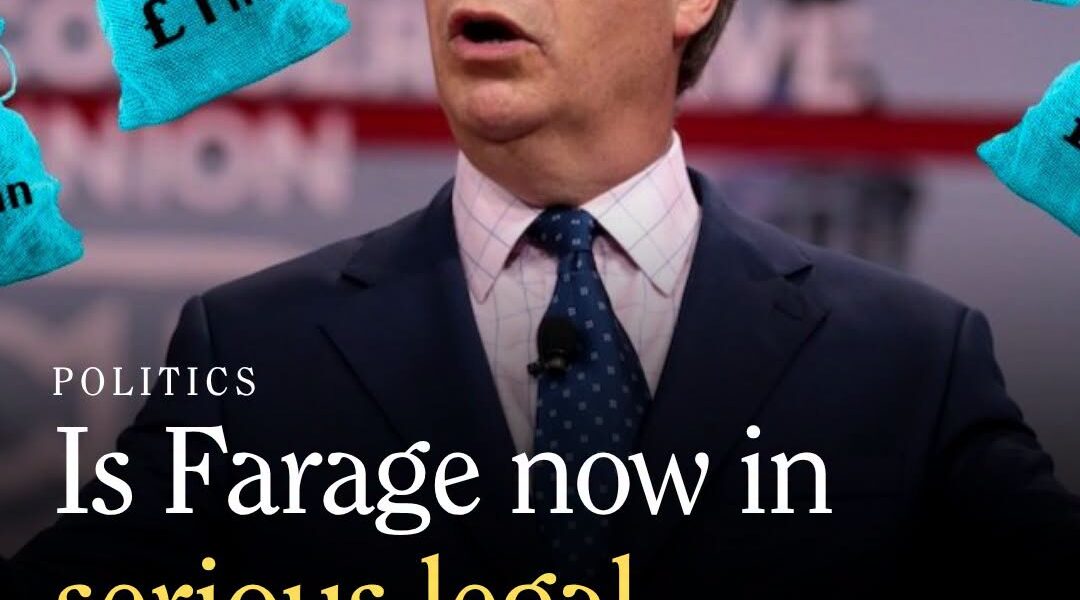
Nigel Farage has now given interviews about his £5m gift to Sally Nugent, Nick Ferrari and Julia Hartley-Brewer in a single morning – and produced a different explanation in each one. He has told the BBC it is “none of your business.” He has told LBC he could spend it “on Ferraris if he wants.” He has told TalkTV it was an unconditional gift he has no obligation to account for. What he has not done, across any of those appearances, is provide a single clear, consistent account of what the money was for, why a crypto billionaire living in Thailand gave it to him, and why it was not declared when he became an MP.
Discover more
Politics
politics
Currencies & Foreign Exchange
There is a reason the story will not go away. When you lay out the timeline of what happened – the payment, the parliamentary career, the crypto policy speeches – the pattern it reveals is one that the Parliamentary Standards investigation was always going to have to take seriously. And if it can be proven that the payment influenced Farage’s actions as a sitting MP, the legal consequences could extend well beyond parliamentary discipline.
Who is Christopher Harborne?
Most people had never heard of Christopher Harborne before this year. The mystery billionaire behind Reform UK lives as a tax exile in Thailand, where he has made his fortune through crypto assets – specifically through significant holdings in Tether and Bitfinex, two of the most prominent and controversial entities in the cryptocurrency world. Tether is the world’s largest stablecoin, pegged to the US dollar. Bitfinex is the crypto exchange with which Tether is closely affiliated. Both have faced regulatory scrutiny in the United States and internationally. Harborne’s financial interests are therefore directly and substantially tied to the regulatory treatment of cryptocurrency globally – and specifically in the UK.
Between Harborne and fellow crypto billionaire Ben Delo – who moved to the UK specifically to fund Reform and has a criminal conviction in the United States related to cryptocurrency compliance – the two men account for nearly two-thirds of Reform’s total fundraising since July 2024. The party’s political operation is, in a meaningful sense, funded by the crypto industry. That fact would be worth knowing regardless of anything else. But it is the personal gift that makes the picture considerably more serious.
Discover more
gifts
Gifts
Breaking News Alerts
The timeline
In late May 2024, Harborne secretly transferred £5 million to Farage personally – not to Reform UK, not as a declared donation, but as a personal gift to an individual who was at that point not a Member of Parliament and had said publicly he was not planning to stand.
Three days later, Farage announced he would stand for Parliament in Clacton.
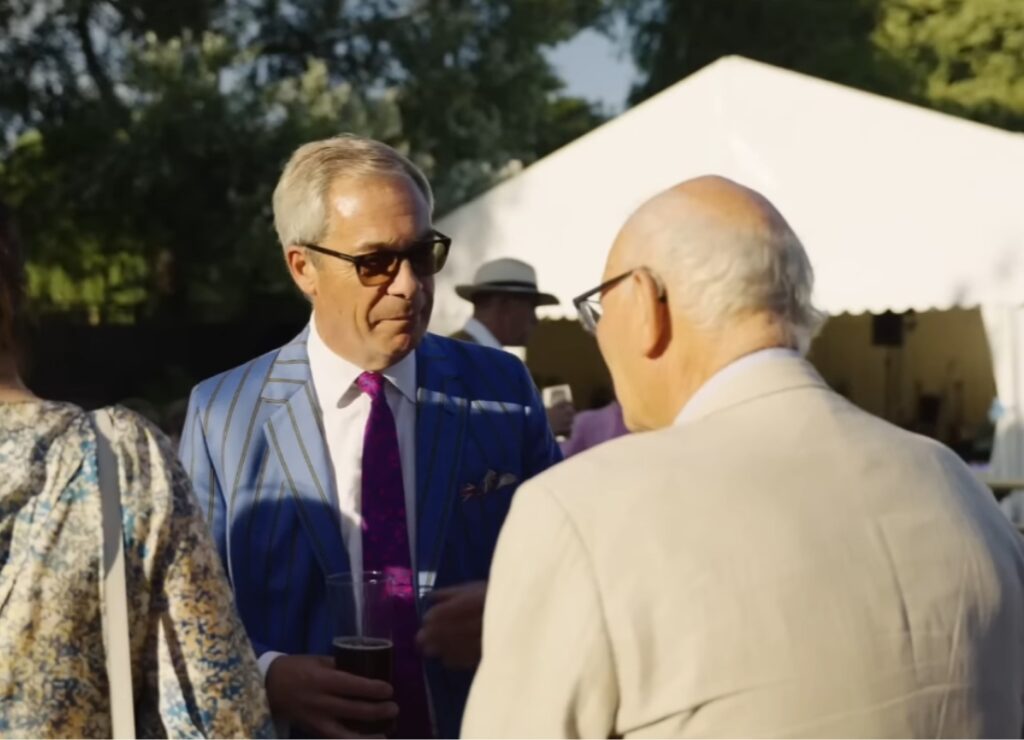
On 4 July 2024, he was elected MP for Clacton. He did not declare the gift.
In the weeks that followed, Farage bought a £1.4m property in cash – weeks after receiving the gift and weeks before standing for parliament. His company accounts appear to contradict his claim that the property was paid for with his I’m A Celebrity fee.
Then, in May 2025, as a sitting MP, Farage announced that Reform UK would become the first British political party to accept donations in Bitcoin. Speaking at the Bitcoin Conference in Las Vegas, he unveiled plans for a Crypto Assets and Digital Finance Bill including reducing capital gains tax on crypto assets from 24% to 10%, creating a Bitcoin reserve at the Bank of England, and preventing banks from debanking crypto users. These are policies that would directly and substantially benefit the financial interests of Christopher Harborne.
In September 2025, Farage publicly namechecked Tether and Bitfinex – the specific companies in which Harborne is a major shareholder – and announced he was going to the Bank of England to argue against restrictions on crypto and against the proposed digital pound. The digital pound – “Britcoin” – is a central bank digital currency that would, if implemented, potentially compete with Tether’s business model and reduce the dominance of private stablecoins in the UK market.
At the Digital Asset Summit in London in October 2025, Farage called for an immediate halt to work on Britcoin. In November 2025, he gave a speech in the City of London again calling for crypto deregulation. Meanwhile, he told a crypto conference he was “prepared to go to prison to stop” the digital pound – a policy that could cost Harborne billions.
The sequence of events – gift, parliamentary candidacy, election, property purchase, crypto policy speeches, Bank of England lobbying on behalf of Harborne’s specific financial interests – forms a chain that the Parliamentary Standards investigation will need to examine carefully.
What Farage says
Farage’s position has shifted considerably since the story broke. His initial explanation was that the money was for personal security – a lifetime of protection given the physical threats he faces. He has since said it was a reward for his work on Brexit. He has also said it was an unconditional gift he could spend on anything he chose. These explanations are not compatible with each other, and he has not resolved the contradiction.
When asked how much of the £5m he has actually spent on security, he has refused to say – telling the BBC’s Sally Nugent that this is “none of your business,” despite acknowledging that hundreds of thousands have been spent. He ran from Sky News cameras when asked about it on the campaign trail. He pulled out of the BBC’s Kuenssberg show days after the story broke. He shut down questions at Reform’s Havering election victory.
He has also claimed that Russia hacked his phone to leak the story to the Guardian – a claim he has never substantiated and which Labour referred to police after he failed to act on a 24-hour ultimatum to provide evidence.
The other financial questions
The £5m gift does not sit in isolation. Farage was found to have breached MPs’ rules 17 times by failing to register £384,000 in earnings – a finding that raised further questions about his relationship with financial transparency. Labour challenged him over a private jet trip apparently connected to Harborne that was valued at just £25,000 – a figure that seemed significantly below market rate.
Former Reform deputy leader Harbi Faige has alleged that Harborne paid Farage and Boris Johnson £1m each in a 2019 election deal and that the £5m “gift” was effectively payment for political services rendered over a longer period. Farage has not addressed this allegation directly. It remains an allegation. But it adds to a picture of a financial relationship between Farage and Harborne that is considerably more complex than a single unconditional gift.
What the law says
The Parliamentary Standards investigation is examining whether the gift should have been declared under the rules governing MPs’ financial interests. Those rules require MPs to declare significant gifts, and while Farage argues the rules did not apply because he was not an MP when the gift was made, the relevant window covers up to a year before an election – within which the gift falls.
But the more serious legal question involves the Bribery Act 2010. Under that legislation, a person commits an offence if they receive a financial advantage intending to perform a function improperly. The most serious bribery offences carry a maximum sentence of ten years’ imprisonment. It is important to be clear: no criminal charges have been brought, no finding of wrongdoing has been made, and Farage is innocent unless proven otherwise. However, the pattern of a payment followed by a parliamentary career followed by repeated policy advocacy directly benefiting the payer is exactly the kind of circumstantial chain that investigators look at when assessing whether the threshold for a criminal referral is met.
Sam, a commentator on social media, put it plainly: “Nigel Farage is in real trouble and he knows it. He was rattled on his interviews today. If it can be proven his £5 million bung was related to political influence, he could ultimately face criminal bribery and corruption charges, which carry up to 10 years in prison.”
His own allies are asking questions
What makes this week significant is not just that hostile journalists are pressing the story – it is that the questioning is now coming from all directions. Kemi Badenoch wrote in the Mail on Sunday that “nobody gets £5m in their pocket for nothing”. Piers Morgan said if any other party leader had accepted a secret gift of this nature, “Farage would demand their resignation. And be right too.” Dan Hodges called the lack of a consistent explanation “incredible, given how long he’s had to come up with a clear line on it.”
Farage has missed 77 consecutive parliamentary votes and has the lowest voting attendance of any Reform MP – a pattern that sits oddly with a man who accepted £5m, says he used it to fund his political career, and then spent much of that career not turning up for it. Even within his own YouTube comment section, voices are beginning to ask the obvious question: “Who gives £5 million without anything in return?”
What happens next
The formal Parliamentary Standards investigation is underway. If the commissioner finds against Farage, the matter goes to the Privileges Committee, which can recommend suspension. A suspension of ten sitting days or more triggers the Recall of MPs Act, which would allow constituents in Clacton to trigger a byelection. That threat is real and is being taken seriously by those close to the investigation.
Separately, the question of whether the pattern of payment and policy advocacy warrants a referral to law enforcement remains open. No such referral has been made. But the timeline – gift, candidacy, election, property, crypto speeches, Bank of England lobbying – is now a matter of public record.
Farage has built his entire political identity on the idea that the establishment protects itself and that ordinary people are locked out. The investigation into his £5m gift is not a media witch-hunt. It is the system he has always claimed to believe in – accountability, transparency, consequences – being applied to him. Whether it can be proven that the money influenced his conduct as an MP is a question for investigators, not commentators.
But the question is legitimate. And the more interviews Farage gives about it, the clearer it becomes that he does not have a clean answer.
-
Joe Connor is a UK-based reporter specialising in politics, public policy, and national affairs. He has previously contributed to publications including The London Economic (JOE Media Group) and Spotted News.
At The Daily Britain, he covers Westminster politics, elections, and breaking political developments, alongside in-depth analysis of policy decisions and their real-world impact.