A Prime Minister in Peril: The Mandelson Vetting Scandal and the Integrity of Downing Street

The atmosphere within the House of Commons has long been defined by its ability to transition from rowdy theater to somber gravity in a heartbeat, but the air in Westminster this week feels markedly different. It is thick with the scent of a political ending, or perhaps a transformative crisis.

For Keir Starmer, the Prime Minister who campaigned on a promise to restore service and integrity to a battered British government, the current moment represents a catastrophic collision between his public identity and a private failure of governance that threatens to dismantle his leadership.
What unfolded at the dispatch box was far more than a routine parliamentary exchange; it was a systematic dismantling of a Prime Minister’s credibility.
The “Mandelson scandal”—a name that now rings with the same ominous frequency as the political collapses of decades past—is no longer just about policy disagreements or the appointment of a controversial figure to a sensitive diplomatic post. It has evolved into a fundamental inquiry into the truth, national security, and whether the ministerial code still carries the weight of law or has become a mere suggestion for those at the pinnacle of power.
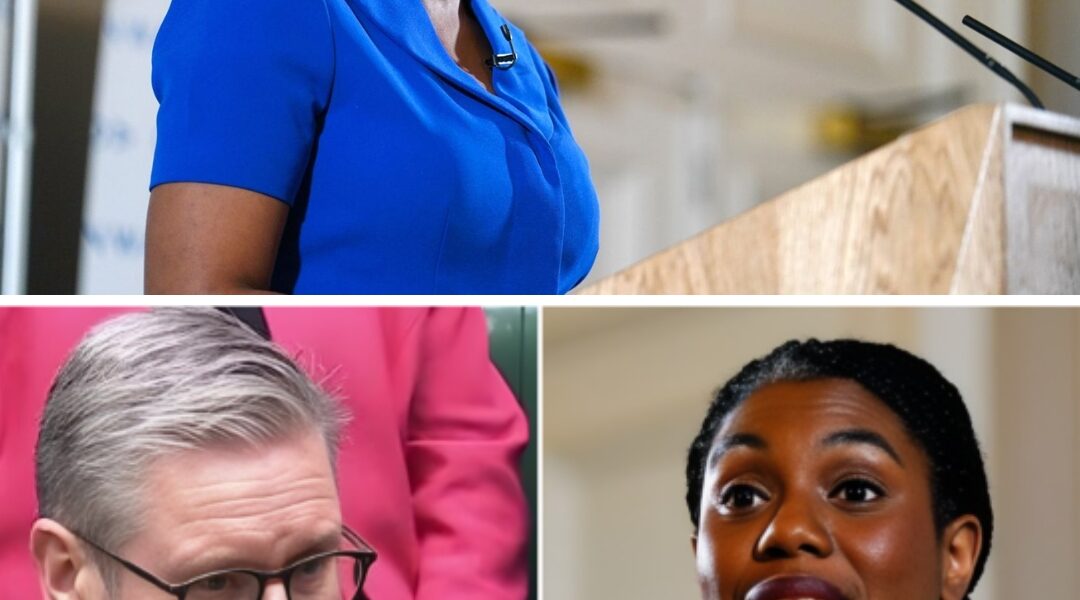
The crux of the crisis lies in the appointment of Lord Peter Mandelson as the British Ambassador to the United States, a role that demands the highest level of security clearance. Kemi Badenoch, the Leader of the Opposition, delivered what many observers described as a career-defining performance, methodically cornering the Prime Minister with a series of six precise, pre-disclosed questions.
The room went still as she reminded the House that Downing Street had already admitted the Prime Minister “inadvertently misled” Parliament—a phrase that serves as a polite euphemism for a breach of the ministerial code.
The allegations are as diverse as they are damaging. Badenoch highlighted Mandelson’s past ties to a convicted sex offender, concerning links to Russian defense companies long after the invasion of Crimea, and, most crucially, a reported failure of the developed security vetting process.
To appoint a national security risk to Britain’s most sensitive diplomatic post is an extraordinary gamble; to do so while claiming “full due process” was followed, as Starmer did in September 2025, is a move that edges toward the indefensible if that process was, in fact, circumvented.
As Badenoch pressed the Prime Minister, the visual contrast was striking. Starmer, a former Director of Public Prosecutions who built a career on the meticulous interrogation of evidence, appeared visibly unsettled, struggling to maintain his characteristic composure. His defense rested on a claim of profound ignorance: that he was “furious” because his advisors and officials had failed to inform him of the negative vetting recommendations until only recently. It is a defense that raises a troubling paradox: either the Prime Minister was aware of the risks and remained silent, or he is so lacking in curiosity that he failed to ask basic questions about a man twice sacked for lying.
The human cost within Whitehall has already been immense. In an attempt to “carry the can”—a phrase Starmer once used to signify personal responsibility—the Prime Minister has instead overseen a purge of the civil service.
The Cabinet Secretary, the Director of Communications, the Chief of Staff, and the Permanent Secretary of the Foreign Office have all been removed. To the Opposition, and increasingly to the public, this looks less like a leader taking charge and more like a leader throwing his subordinates under the bus to preserve his own position.
“I will carry the can for the mistakes of any organization I lead,” Starmer famously said before he took office. Yet, in the face of the Mandelson fallout, that “can” has been passed to every official within reach. The narrative of the “incurious leader” is particularly damaging for a man whose brand is rooted in legalistic precision. If the Prime Minister did not know that a political appointee had failed security vetting, it suggests a breakdown in the basic machinery of Downing Street that is as frightening as it is embarrassing.
Even more troubling is the question of the Epstein links. Badenoch pointed out that in February 2026, Starmer told the House that Mandelson’s vetting had revealed the extent of his relationship with the late financier Jeffrey Epstein. This creates a logical trap: if Starmer had not seen the vetting file, as he now claims, how could he have spoken so authoritatively about its contents months ago? His response—that he was referring to “due diligence” rather than “security vetting”—felt like a semantic retreat that did little to soothe the growing skepticism in the chamber.
The national security implications cannot be overstated. A failure in the vetting process for the US Ambassador role does not just affect British interests; it strains the “Special Relationship” itself. If the UK’s primary representative in Washington was deemed a risk by his own country’s security services, the flow of top-secret intelligence between the two nations could be compromised. This is why the scandal has resonated so far beyond the Westminster bubble; it touches on the safety and global standing of the United Kingdom.
Trust, as Starmer surely knows, is a fragile commodity. It is built over years of consistent transparency and can be shattered by a single week of murkiness. The Prime Minister’s insistence that he acted on all information “available” to him ignores the reality that a Prime Minister has the power to make any information available with a single phone call. By choosing not to ask, he effectively chose not to know, allowing a political ally to continue in a role for which he was functionally disqualified by the security apparatus.
The ghost of past administrations now haunts the dispatch box. Badenoch was quick to remind Starmer of his own words in January 2022, when he told a previous Prime Minister that “if he misled the house, he must resign.” It is a quote that has become a millstone around Starmer’s neck. In politics, the standard you set for your enemies eventually becomes the standard by which you are judged, and the public is rarely forgiving of those who claim a “one rule for them, another for me” exemption.
As the exchange concluded, the feeling in the Commons was not one of closure, but of an opening. More documents are likely to emerge, more officials may speak out, and the contradictions in the government’s timeline will be picked over by select committees for months to come. This is the kind of political wound that does not heal with a simple apology or a cabinet reshuffle; it festers because it suggests a fundamental flaw in the Prime Minister’s judgment and his commitment to the very truth he promised to uphold.
Ultimately, the Mandelson scandal is a test of character. In his effort to respond, Starmer emphasized that he wanted to provide a “full account” to the House once he had the legal facts. But a full account that arrives only after a media firestorm and a series of high-level sackings feels less like transparency and more like damage control. The integrity of Downing Street depends on a Prime Minister who is the first to know the truth, not the last to admit it.
For many observers, the most damning part of the day was the realization that the Prime Minister’s reputation for being “above the fray” has been permanently altered. He has entered the same murky waters that he once criticized with such legalistic fervor. Whether he can swim to the other side remains to be seen, but the weight of the Mandelson affair is pulling him deeper into a crisis of his own making. In the unforgiving world of British politics, the distance between the dispatch box and the exit has never felt shorter.