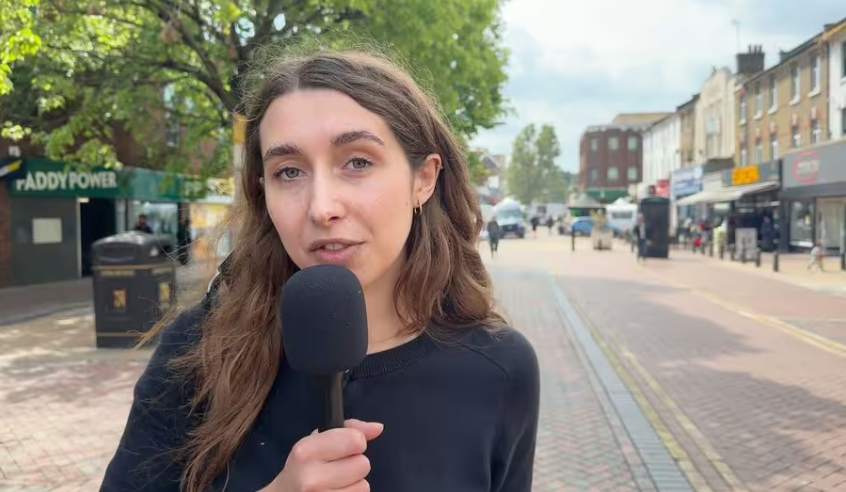


Reform UK won a historic majority on Thurrock Council in this week’s local elections (Image: Tim Merry)
If there is a core message to be taken from this week’s local elections, it is that people want change. Dissatisfaction with the political centre ground saw insurgent right and left-wing parties, Reform UK and the Greens, make historic gains in Labour heartland seats on Thursday, while Sir Keir Starmer’s premiership now looks more on the brink than ever.
Nigel Farage and Zack Polanski were respectively jubilant about their parties’ success, but on the streets of Thurrock, in Essex, where Reform took 45 of the 49 seats up for grabs, voters were more weary than excited when asked about their choices at the ballot box.
By and large, the people milling about in Grays, the borough’s largest town, and South Ockendon fall into two groups. On one hand, the Reform enthusiasts are thoroughly fed up with the last few decades of both Labour and Conservative rule, and believe Mr Farage has the silver bullet to making streets safer, cutting illegal immigration and boosting the economy.
Mike Bronze, 66, who switched his vote from Tory to Reform last year, says: “The people of England, Scotland and Wales have had enough of the establishment. With the world the way it is at the moment, drastic things need to be done. Reform could go down that route and give us a bit of hope.”
Read more: Labour’s 2026 election wipeout mapped as Reform make huge gains – check area
Read more: Readers debate if Nigel Farage will be the next prime minister

Mike Bronze is among the voters who believe only Reform UK can fix the country (Image: Tim Merry)

Voters in Thurrock couldn’t muster up much enthusiasm about the state of UK politics (Image: Tim Merry)
Leanne Holland, 39, who works as a carer for her mother, adds: “I can’t get a flat. We’ve got a real problem with housing and Labour are just bringing more and more people here. Reform is for the British people. They’re looking at what we want.”
Others are disenchanted non-voters or those sticking with the traditional two parties out of beleaguered loyalty and a lack of appealing alternatives. One admits the Conservatives made mistakes both nationally and locally – the Tory-run Thurrock administration went bust in 2022 with over £1billion in debt – but half-heartedly suggests they might do better next time.
Jatinder Atwal, 58, who voted Labour, as he has always done, admits that Keir Starmer has made “mistakes” in Number 10 and that Labour councillors – who have been in control since 2024 – “could have done more to support local businesses”.
A mum-of-four who has always based her vote on “the candidate, not the party”, chose to abstain altogether for the first time this year. She understands why others have moved towards Reform, but is put off by Mr Farage’s stance on immigration.
No one else has made an appealing case, and local politicians are too preoccupied with national talking points – whether international conflicts or open borders, she says.
While generally unenthusiastic, opinions on the ground are also undeniably anti-Keir Starmer, who appears to have whatever the opposite of a cult of personality might be.
Carol Carter, 83, who has always voted Conservative despite not being able to identify Kemi Badenoch as the party leader, voices particular dissatisfaction with Sir Keir, primarily based on an instinctive response to his cautious, serious and largely unpopular public image.

Jatinder Atwal, a long-time Labour voter, doesn’t have much hope in local or national leaders (Image: Tim Merry)

Carol Carter, who always votes Conservative, has a ‘personal’ dislike of Keir Starmer (Image: Tim Merry)
“I don’t think he’s a very good leader,” she says. “It’s just personal feelings, isn’t it?”
While immigration is an issue on many Thurrock voters’ lips, it’s not difficult to draw a line between the desire for change of any kind and the numerous empty units, as well as the shoppers scrabbling around in their purses for change.
Despite this, and local election turnout often being low, it’s striking how many people have exiled politics from their lives entirely, viewing it as something remote and futile, rather than an expression of their democratic rights.
More than one person, asked about their vote, replies with something to the tune of: “I don’t know anything about that, it doesn’t concern me.”
One struggling education worker thanks us for roaming the county’s streets in a bid to establish and broadcast the vox populi. “This is what the politicians should be out doing,” they add. “People here just feel forgotten.”
It’s a message that cuts to the heart of public frustrations with the Government, and the party infighting almost sure to characterise the coming days and weeks in lieu of communicating in earnest with the voters in whose hands their future lies.
A failure to change tack will only cement people’s views of Westminster as weak and ineffectual at best, uncaring and vindictive at worst. This week was the first time Britons have had their say en-masse since the 2024 election, and the verdict has been a damning one, for Mr Starmer and Labour undoubtedly, but also for trust in politics as a whole