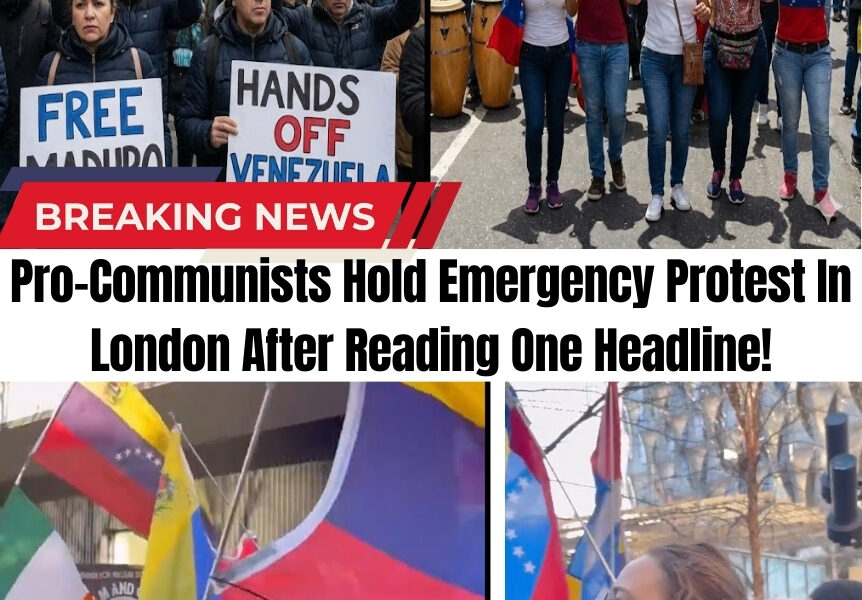
Pro-communist activists sparked outrage by rushing to defend Nicolás Maduro outside the U.S. Embassy in London, demanding his release after his dramatic capture. Their chants clashed sharply with scenes of Venezuelans worldwide celebrating what many see as the end of a brutal era. Viral videos exposed a stunning disconnect, with critics accusing protesters of backing a dictator the Venezuelan people overwhelmingly reject. As celebrations erupted in Caracas and exile communities, the London protest raised an awkward question: who were these activists really speaking for?


Pro-communist activists staged an emergency protest outside the U.S. Embassy in London, demanding the release of Venezuelan President Nicolás Maduro after his controversial capture. The protest, fueled by outrage over U.S. intervention, was marked by fervent speeches and colorful banners, but it raised eyebrows among those aware of the true sentiments of Venezuelans.
The scene was chaotic, with passionate protesters waving flags and chanting slogans, but their message seemed misaligned with the reality in Venezuela. Many Venezuelans, both at home and abroad, were reportedly celebrating Maduro’s removal, viewing it as a long-awaited opportunity for change. This disconnect sparked a wave of criticism directed at the protesters, who appeared to be rallying around a narrative that contradicted the voices of the very people they claimed to support.
Videos from the protest circulated online, showcasing the fervor of the demonstrators, but also revealing the stark contrast between their cries for Maduro’s freedom and the jubilation expressed by Venezuelans celebrating his downfall. Critics of the protest pointed out that many participants seemed uninformed about the complexities of the situation, reducing their activism to mere headline reactions.
One Venezuelan protester, who openly criticized Trump yet expressed joy over the recent developments, highlighted the confusion surrounding the protest. “We are stoked,” she said, emphasizing that the majority of Venezuelans not aligned with the government were thrilled at the prospect of change. Her comments underscored a growing frustration with those who misinterpret the desires of the Venezuelan people.
As the protest unfolded, it became clear that the demonstrators were not only out of touch with Venezuelan sentiments but also seemingly oblivious to the historical context of their actions. The irony of demanding freedom for a leader who had been widely criticized as a dictator was not lost on observers, who questioned the sincerity and effectiveness of the protest.
The event in London mirrored similar protests in New York, where activists also rallied for Maduro’s release, further illustrating a pattern of misalignment with the actual feelings of Venezuelans. As the situation continues to evolve, it remains to be seen how these protests will impact public perception and the ongoing discourse surrounding U.S. foreign policy.
In the end, the emergency protest serves as a striking reminder of the complexities of global politics and the challenges of truly understanding the voices of those affected. As the world watches, the contrast between celebration and protest highlights the urgent need for informed dialogue and genuine solidarity with the people of Venezuela.