
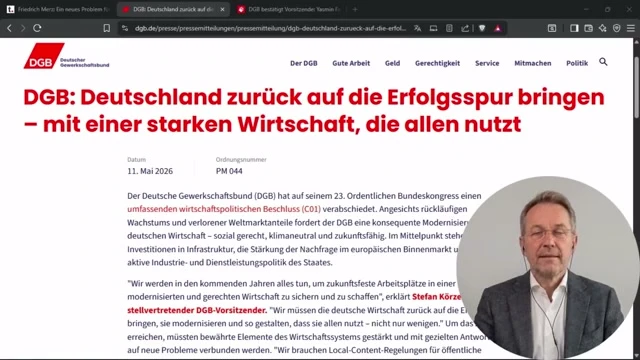
Beim DGB-Bundeskongress in Berlin ist es zu einer offenen Konfrontation zwischen dem Deutschen Gewerkschaftsbund und der Regierung unter Bundeskanzler Friedrich Merz gekommen. DGB-Vorsitzende Jasmin Fahimi, die mit 96 Prozent der Stimmen im Amt bestätigt wurde, warf der Regierung in ihrer Grundsatzrede „Rentenklau“ vor. Sie erklärte, die geplanten Vorhaben seien keine Reform, sondern eine „Einschränkung eurer Gesundheitsversorgung“. Der DGB sei „mobilisierungsfähig und mobilisierungsbereit“, um diese Politik abzuwehren. Der Verband vertritt nach eigenen Angaben 5,4 Millionen Mitglieder in acht Einzelgewerkschaften, darunter IG Metall, Verdi und IGBCE.

Fahimi kritisierte konkret mehrere Vorhaben der Regierung. So solle der Bundeszuschuss zur gesetzlichen Krankenversicherung von 14,5 auf 12,5 Milliarden Euro gesenkt werden – ein Minus von zwei Milliarden Euro bei einem System, das laut Quelle ein „Milliarden Loch“ von 15 Milliarden Euro aufweist. Zudem sei geplant, den Krankengeldsatz von 70 auf 56 Prozent des Bruttogehalts zu senken und sogenannte Teilkrankschreibungen einzuführen, bei denen Ärzte den Grad der Arbeitsunfähigkeit in 25-Prozent-Schritten festlegen sollen. Dies setze Kranke unter Druck, vor der vollständigen Genesung an den Arbeitsplatz zurückzukehren.

Im Bereich der Rente habe Merz laut Quelle erklärt, die gesetzliche Rente werde künftig nur noch eine „Basisabsicherung“ darstellen. Diese Aussage habe er in einer öffentlichen Rede vor dem Bankenverband getätigt. Darüber hinaus plane die Regierung eine Flexibilisierung des Acht-Stunden-Tages, was Arbeitgebern ermöglichen solle, die klassische Arbeitszeitregelung aufzuweichen. Der DGB lehne dies ab. DGB-Vorstandsmitglied Stefan Kürzel bezeichnete den Bundeskanzler vor den Delegierten als „Oberpfleger der Reichen“ und sprach von „Reichtumspflege“ durch die Union. Die Delegierten reagierten mit lautem Jubel.
Fahimi stellte den Regierungsplänen eigene Forderungen gegenüber. Sie sprach sich für die Wiedereinführung einer Vermögenssteuer, eine gerechtere Erbschaftssteuer und einen höheren Spitzensteuersatz aus. Steuererleichterungen benötigten die Arbeitnehmer, nicht die Unternehmen. Dies stehe im direkten Gegensatz zur Wirtschaftspolitik von Merz, die auf Körperschaftssteuersenkungen und Entlastungen für Unternehmen setze. Laut einer vom DGB zitierten Umfrage befürworteten 77 Prozent der Deutschen eine gemeinsame Rentenversicherung, und 75 Prozent würden höhere Beiträge akzeptieren, wenn das Niveau stabil bleibe.

Die DGB-Vorsitzende Fahimi ist ehemalige Generalsekretärin der SPD und kennt die Partei nach eigener Aussage von innen. Sie machte deutlich, dass die SPD in der Koalition unter Druck stehe, Gewerkschaftsstandpunkte zu unterlaufen. Mit ihrer harten Haltung verschärfe sie den Druck auf die SPD-Spitze. Der DGB habe die Agenda für die kommenden Monate auf Widerstand ausgerichtet. Die Frage sei nicht mehr, ob die Regierung scheitere, sondern wann. Der genaue Zeitpunkt weiterer Eskalationen oder möglicher Massenproteste bleibt in der Quelle jedoch unbekannt.
WILLOW DIDN’T JUST SUSPECT JACINDA… SHE FOUND THE TRUTH 💣SPOILER ALERT: THE SECRET WILLOW UNCOVERED COULD DESTROY EVERYTHING

Spoiler alert—this is the moment everything shifts. Willow is no longer reacting, no longer begging, and definitely no longer relying on the courts to win back control of her life. When she said she would “find another way,” it wasn’t desperation—it was a decision. Something in her changed. Instead of fighting Michael and Jacinda in the open, Willow has gone quiet… and that silence feels far more dangerous than any threat she’s made so far.

At first, it looks like jealousy. That’s the easy explanation. Willow sees another woman around her children, hears things she doesn’t like, and lashes out. But if you look closer, there’s something off about the way she reacts to Jacinda. It’s not just emotional—it’s observant. Willow isn’t just angry… she’s studying her. The way Jacinda speaks, the confidence she carries, the way she pushes back—it doesn’t feel like someone caught in the middle of a messy relationship. It feels like someone who knows more than she should.
And that’s where the real shift begins. Instead of escalating the conflict, Willow pulls back. That’s the clue. Because this isn’t about confrontation anymore—it’s about investigation. What if Willow has started asking the question no one else is asking? What if Jacinda isn’t just Michael’s girlfriend… but a piece of something bigger? The timing of her arrival, her connection to recent events, the way she inserts herself into situations—it all starts to look less random and more intentional.
As Willow begins to dig, the possibilities become explosive. What if Jacinda has a past that links her to the chaos surrounding Drew? What if she was involved—directly or indirectly—in the events that left him vulnerable? And what if that connection leads back to people Willow already knows? Suddenly, Jacinda isn’t just a romantic rival. She’s a potential liability. A secret waiting to be uncovered. And Willow is exactly the kind of person who knows how to turn secrets into weapons.

Because here’s the twist—Willow doesn’t expose the truth. Not right away. She holds onto it. That’s what makes this so dangerous. She’s not looking for justice. She’s looking for leverage. If she can prove that Jacinda isn’t who she claims to be, she doesn’t just remove her from Michael’s life—she controls the entire narrative. And once Willow controls the narrative, she controls everything: the custody battle, Michael’s trust, even how the truth about her own actions is perceived.
This puts Michael in an impossible position. If Willow reveals Jacinda’s secret, everything he believes about his new relationship could collapse instantly. But if she keeps it hidden, she gains power over both of them. That’s the game now. Not love. Not loyalty. Control. And the most unsettling part is that Michael may not even realize he’s already caught in it. Because Willow isn’t acting impulsively anymore—she’s thinking several moves ahead.
And that’s where the story takes a darker turn. Willow, who once struggled to break free from manipulation and control, is starting to mirror the very behavior she escaped. She watches instead of reacts. She calculates instead of confesses. She waits. This isn’t the same woman who was once overwhelmed by circumstances. This is someone who has learned how power works—and isn’t afraid to use it.
Heading into what feels like a full-scale explosion, everything hinges on one question: what will Willow do with what she finds? If Jacinda’s secret comes out, it could destroy her, destabilize Michael, and drag Nina deeper into a situation that’s already spiraling. But if Willow keeps that secret… she becomes the most dangerous person in the room. Because the truth, in her hands, isn’t just information—it’s a weapon.
So the real twist might not be what Jacinda is hiding. It might be what Willow chooses to do with it. Because this isn’t jealousy anymore. It’s strategy. And if Willow has truly figured out who Jacinda is… then the next move won’t be a fight. It will be a takedown.